
A CIO I follow posted something this week I've not been able to put down. She runs AI at one of the big UK banks, and her point was deceptively simple… stop asking where agents fit into your process, start asking what the process should even be now that agents exist. Agents reason. Systems execute. The interesting decisions, she said, all sit at the boundary — what an agent may decide, what a system must enforce, and where a human stays accountable.
I read that last line about four times. It’s a beautiful description of the destination… and if you’ve been following this series you’ll recognise most of it, told in an engineer’s accent rather than mine. She’s right, and she’s ahead of most of the market in saying it out loud.
Here’s the thing she doesn’t say, though, and I don’t think she needs to, because it isn’t her job to… naming the boundary is not the same as knowing who stands on it. Someone, somewhere in that organisation, has to actually make the call. This decision, the agent can own. That one, no chance — route it to a system with an audit trail. This other one is genuinely consequential, so a named human keeps their hand on it. Those aren’t architecture decisions. They’re judgement calls, made under uncertainty, usually with money or trust or someone’s safety sitting on the outcome. The diagram doesn’t make them. A person does.
So who is that person?
In the last article, Why People Follow, I explored the idea that people follow credibility and trust, both built through exposure over time. If AI quietly removes the work that used to generate that exposure, I ended on an unresolved worry rather than an answer. This is me trying to answer it.
Because a person only earns the right to stand on that boundary by climbing something. I’ve sketched it out more times than I’d like to admit, and it keeps coming back to the same shape. Knowledge becomes expertise. Expertise, tested against real experience, starts to become judgement… but only if that experience comes with enough of the right exposure, and only if someone actually reflects on it rather than just moving on to the next task. Judgement becomes credibility. Credibility, sustained over time, becomes trust. And trust is what people are actually following when they follow a leader, whatever the org chart says.
The uncomfortable bit is that trust and credibility are relational. They’re built between specific people, in a specific organisation, over time. They cannot be imported. That’s the whole problem with the obvious answer.
Because the obvious answer already exists, and it’s a good one. The Forward Deployed Engineer. Borrowed from Palantir, adopted everywhere from OpenAI to the big consultancies over the last year or so, postings up something like 800% — a rare, judgement-rich engineer who embeds with you, builds the actual system, and stays until it runs. Not a deck. Not a recommendation. A person, in the room, making the calls.
It works. I want to be clear about that. When you need judgement now, and the person offering it has genuinely seen the pattern before, that’s a real and valuable thing to buy.
What it doesn’t solve is what happens after they leave.
Their judgement was never really yours. It was rented. The trust they built was theirs, with your team, for the duration of the engagement. When the contract ends, the system stays, the documentation stays, and the judgement mostly walks out the door with them. You’re back where you started, except now you also know how good it felt to have someone who just… knew.
Which is the market’s answer to the gap. It isn’t yours.
Your organisation’s answer, if you want to actually own this rather than keep renting it, is Option 2. Build the muscle. Grow your own people up that same climb — knowledge, expertise, experience, exposure, judgement, credibility, trust — until someone on your own payroll can stand on the boundary with the same confidence as the person you’d otherwise have hired in.
I’ve watched this work. I built it, at GSK, inside one of the most regulated industries there is. It started with eight curious people, meeting for an hour a week, learning together on real business problems rather than sitting through abstract training. No mandate. No meaningful budget. Just a hypothesis that Power Platform, agile ways of working and a community that set its own direction could build digital capability differently — and a habit of removing blockers rather than controlling the work. By Q4 2020 that was 2,900 people. By the time I moved on, it was the Power Rangers — over 4,500 people, across more than 70 countries, with visibility and sponsorship reaching the C-suite. Nobody set out to build a movement of that size. It compounded the same way judgement does — project after project, pattern after pattern, story after story told at the next show-and-tell.
That’s proof it’s possible. It’s also proof it’s slow, and that most organisations aren’t sitting on the specific conditions that made it possible — the air cover, the community instinct, the years.
So Option 1 is fast, but you don’t own it. Option 2 you own completely, but it’s genuinely, properly slow, and most organisations can’t honestly bootstrap it from nothing.
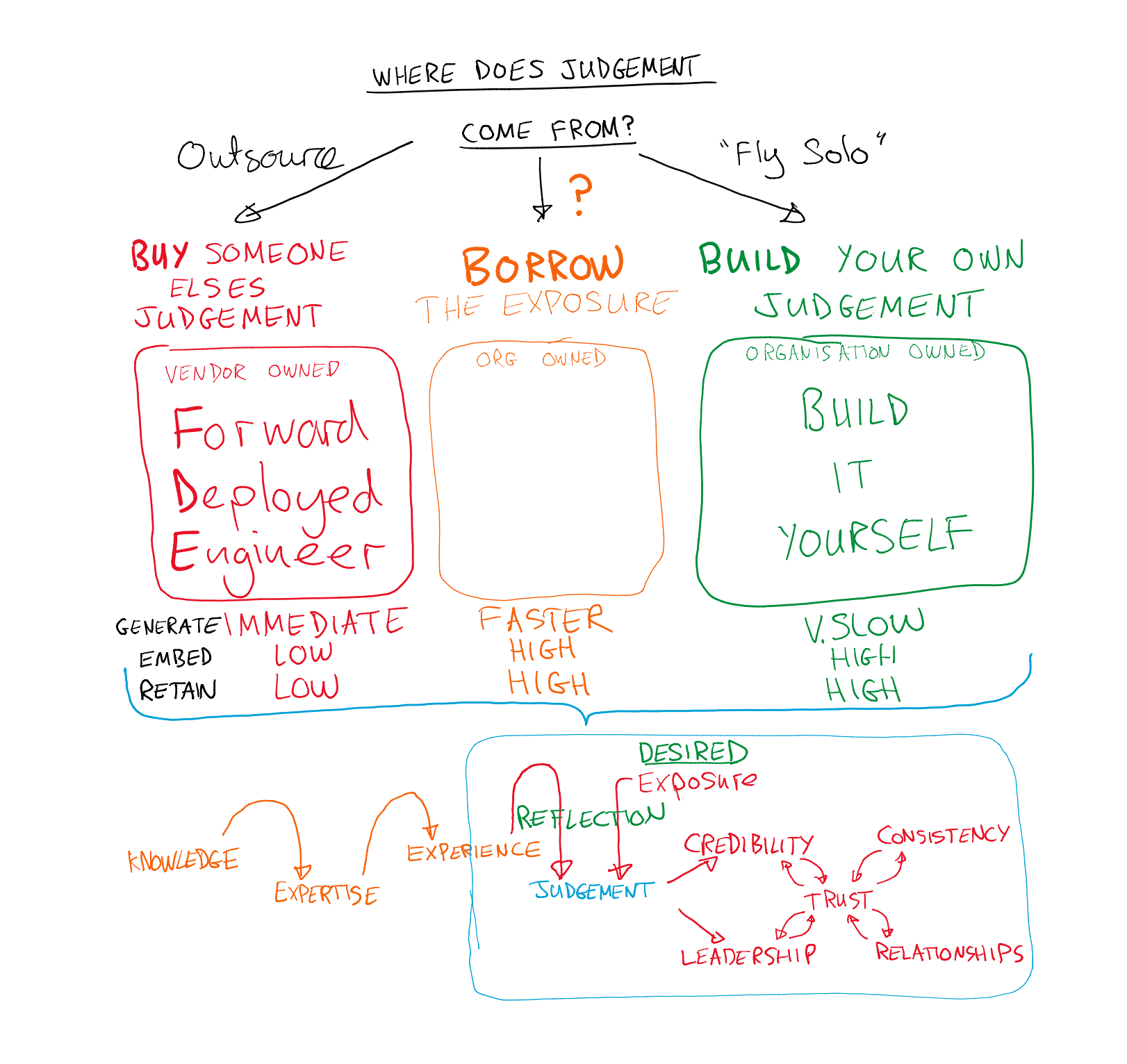
A hand-drawn diagram titled "Where Does Judgement Come From?" showing three paths branching from that question: Buy (outsource, via a Forward Deployed Engineer), Borrow (marked only with a question mark), and Build (build it yourself). The middle option is deliberately left unresolved.
Where does judgement come from? Buy it, build it — or something in between still taking shape.
Is there a third way. Not rented, and not solo. I’ve got a rough shape for it — something closer to borrowing the exposure rather than the judgement itself, so the muscle that grows is still yours, still embedded, still there after everyone’s gone home… but I haven’t fully worked out what that looks like yet, or what to call it. I’ll come back to it.
For now, the choice I keep landing on isn’t build versus buy. It’s this: the industry’s answer to the capability gap is to send you a brilliant person. The better question is what you build so you never need to borrow one again.
Because capability, it turns out, isn’t really an event. It’s a system. And that’s where I want to go next...
Exploring Human Capability in an AI World
This article is part of an ongoing series exploring how AI may reshape knowledge, expertise, experience, judgement, trust and organisational capability.
Part 1: What If Knowledge Was Free?
Part 2: Information Isn’t Knowledge. Knowledge Isn’t Wisdom.
Part 3: The Capability Factory.
Part 4: The Hidden Curriculum.
Part 5: Capability Compounds Through Exposure.
Part 7: Where Does Judgement Come From?
Coming Next: If capability doesn’t develop by accident anymore, what replaces the old model? Exploring why organisations may need to think of capability as an ecosystem, not a training programme.
About This Series
This series began by exploring what happens when information and knowledge become increasingly abundant. It has since examined where human value sits, how capability is developed through work, the hidden curriculum embedded within tasks, how capability compounds through exposure, why credibility and trust are central to leadership, and now where judgement itself actually comes from. Future articles will explore capability ecosystems, capability density, and why the organisations that build systems for continuous capability regeneration may be the ones that thrive.
