
A couple of weeks ago I found myself sketching, exploring ideas for explore where a transformation network might fit in a world where AI becomes available to every organisation, regardless of size, budget or access to specialist support. A question then popped into my head:
What if knowledge was free?
At first glance it's a ridiculous question. Knowledge has never been free.
Organisations spend billions every year acquiring it. They hire consultants, buy research, attend conferences, subscribe to analyst services, send people on training courses and recruit specialists specifically because knowledge has value. Entire industries exist because some people know things that other people don't.
AI can’t do all that reliably at the moment. Then I thought… AI doesn't need to make knowledge perfect. It doesn't even need to make knowledge free.
It only needs to make knowledge significantly cheaper and significantly more accessible than it has ever been before - I think we're already there!
If I need a strategy framework, a first draft proposal, a technology comparison, a business case structure or an explanation of a concept, I can get something useful within seconds. Ten years ago I would have spent hours searching or creating. Twenty years ago I would probably have been pulling books off shelves or calling somebody I knew.
The quality isn't always perfect. The answer isn't always right. Expert review still matters.
But that's not the point… The point is that the economics have changed. Whenever something that was previously scarce becomes abundant, the market around it changes too. We see that all the time with technology changes.
Which led me to another question…
If knowledge is becoming abundant, what are organisations actually paying for?
The more I thought about it, the more I realised that we often bundle several very different things together under the banner of "expertise".
Knowledge is the obvious one. It's the what. The information, facts, concepts, methods and frameworks. But knowledge isn’t the whole story.
There's expertise, which is knowing how to apply that knowledge in a specific context.
There is experience, which is understanding what actually works in the real world because you've tried things, succeeded, failed, adapted and learned.
Then there's judgement, which is often the most valuable and least visible asset of all. Judgement is knowing when to act, when not to act, what to prioritise, what to ignore and which trade-offs are acceptable.
As I played with the idea, it struck me that AI affects each of those things very differently. Some more, some less.
Knowledge is being unlocked.
Expertise is being amplified.
Experience is becoming easier to share.
Judgement can be informed and supported, but it still feels fundamentally human.
… At least for now.
What's interesting, though, is that this isn't just an AI thing. I’ve seen and been part of these network stories before.
Years ago at GSK we built a global community of 'Power Rangers' around Power Platform. What surprised me wasn't that people learned from the community. It was how much more effective the community became than the traditional change management approaches we had relied on before.
Knowledge spread faster.
Ideas spread faster.
Successful behaviours spread faster.
Teams learned from other teams rather than waiting for central guidance.
People who had solved a problem shared their experience with people who hadn't.
Capability started to compound.
The community became a force multiplier.
It was EXCITING!
Later I saw similar patterns elsewhere.
The most effective transformations were rarely driven solely by programme teams, governance boards or communications campaigns. Those things all matter, but the transformations that really gained momentum were almost always people focused and supported by networks. Informal networks. Champion networks. Communities of practice. Groups of people who cared enough to share what they had learned and help others succeed.
In hindsight, maybe that shouldn't have been surprising. People have always learned from other people - Technology changes. Human behaviour doesn't change nearly as fast.
The Microsoft MVP programme and community events and conferences are other fantastic examples.
Every day, thousands of people all over the world freely share knowledge, expertise and experience. Most aren't doing it because somebody is paying them. They're doing it because they care about the technology, enjoy solving problems and get genuine satisfaction from helping others.
The result is an extraordinary distribution mechanism for capability.
Questions get answered.
Lessons get shared.
Mistakes get avoided.
New ideas emerge.
The whole system becomes more valuable because the network exists.
What's particularly interesting is that the value comes from connection… Not ownership.
More recently I've noticed similar conversations beginning to appear around AI transformation. Organisations are increasingly talking about champions, communities, peer learning, networks and grassroots adoption because they're discovering something many of us have already experienced first-hand. Deploying technology is relatively straightforward. Embedding meaningful change across thousands of people is considerably harder.
Technology scales.
Trust doesn't.
Behaviour doesn't.
Experience doesn't.
Those things move through networks.
And that brings me back to the sketch that started this whole train of thought.
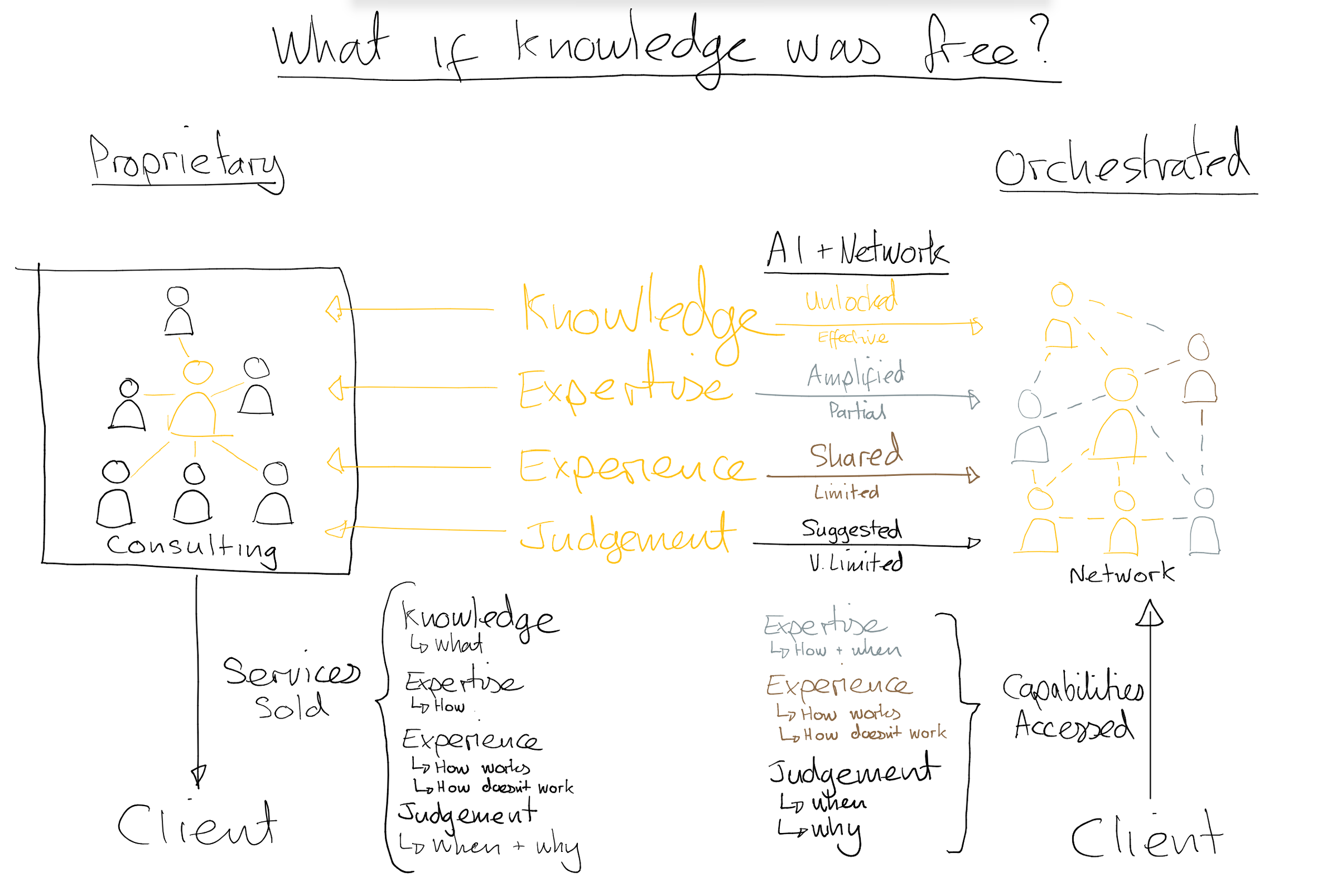
This diagram explores how AI and networks may be changing the way organisations access external capability. Historically, knowledge, expertise, experience and judgement were concentrated within consulting firms and accessed through purchased services. As AI makes knowledge more accessible and networks make expertise and experience easier to share, organisations may increasingly gain access to capability through connected ecosystems rather than traditional proprietary models. The diagram poses a simple question: What if knowledge was free? and explores the potential shift from ownership to access.
Historically, consulting firms have created enormous value by owning knowledge, expertise, experience and judgement. Clients bought services because that was the most effective way to access those assets.
But what happens when one of those assets becomes dramatically more accessible?
What happens when knowledge no longer needs to sit behind organisational walls?
What happens when expertise can be amplified by AI?
What happens when experience can be shared across communities and networks?
What happens when organisations can access capability from connected ecosystems rather than single providers?
I don't know the answer… Genuinely… We’re already seeing disruption from these changes though! I have some thoughts and ideas that I’ll share in follow up posts as I consider them some more.
This post isn't a prediction and it certainly isn't a conclusion. It's an interesting thought experiment though, isn't it?
The more I think about AI and the more I look at successful communities, transformation networks, champion programmes and ecosystems like the MVP programme, the more I suspect we're looking at the disruption through the wrong lens.
Most conversations focus on AI replacing work. I wonder whether the bigger shift is AI changing how organisations access capability.
Perhaps the future isn't about who owns the most knowledge.
Perhaps it's about who learns the fastest.
Because if AI is making knowledge abundant, then knowledge itself may no longer be the advantage.
The advantage may come from how quickly organisations can turn knowledge into expertise, expertise into experience and experience into better decisions.
I'm not sure where that leads yet. But I think it's a much more interesting question than whether AI can write a report or build a PowerPoint deck. The future is going to be interesting, I'm sure!
Exploring Human Capability in an AI World
This article is part of an ongoing series exploring how AI may reshape knowledge, expertise, experience, judgement and organisational capability.
✅ Part 1:What If Knowledge Was Free?
Up Next: Information Isn't Knowledge. Knowledge Isn't Wisdom
About This Series
The first articles in this series explore what may be changing as information and knowledge become increasingly abundant, what remains uniquely valuable, how organisations develop human capability, and the hidden capabilities that work develops along the way.
Future articles will explore the consequences of these changes and the new models that may emerge as a result.
