
Why Most Organisations Get Stuck Between AI Adoption and Transformation
Current State
I've spent years helping organisations adopt Low-Code and AI, and I've noticed they tend to fall into one of three camps.
Some are chasing productivity gains
Some are running endless pilots, proofs of concept and use case experiments
A much smaller number are thinking about org-wide Transformation
These are often treated as three different strategies… and that’s why I think they get stuck. I believe they are different stages of the same journey and should be considered within a single business strategy.
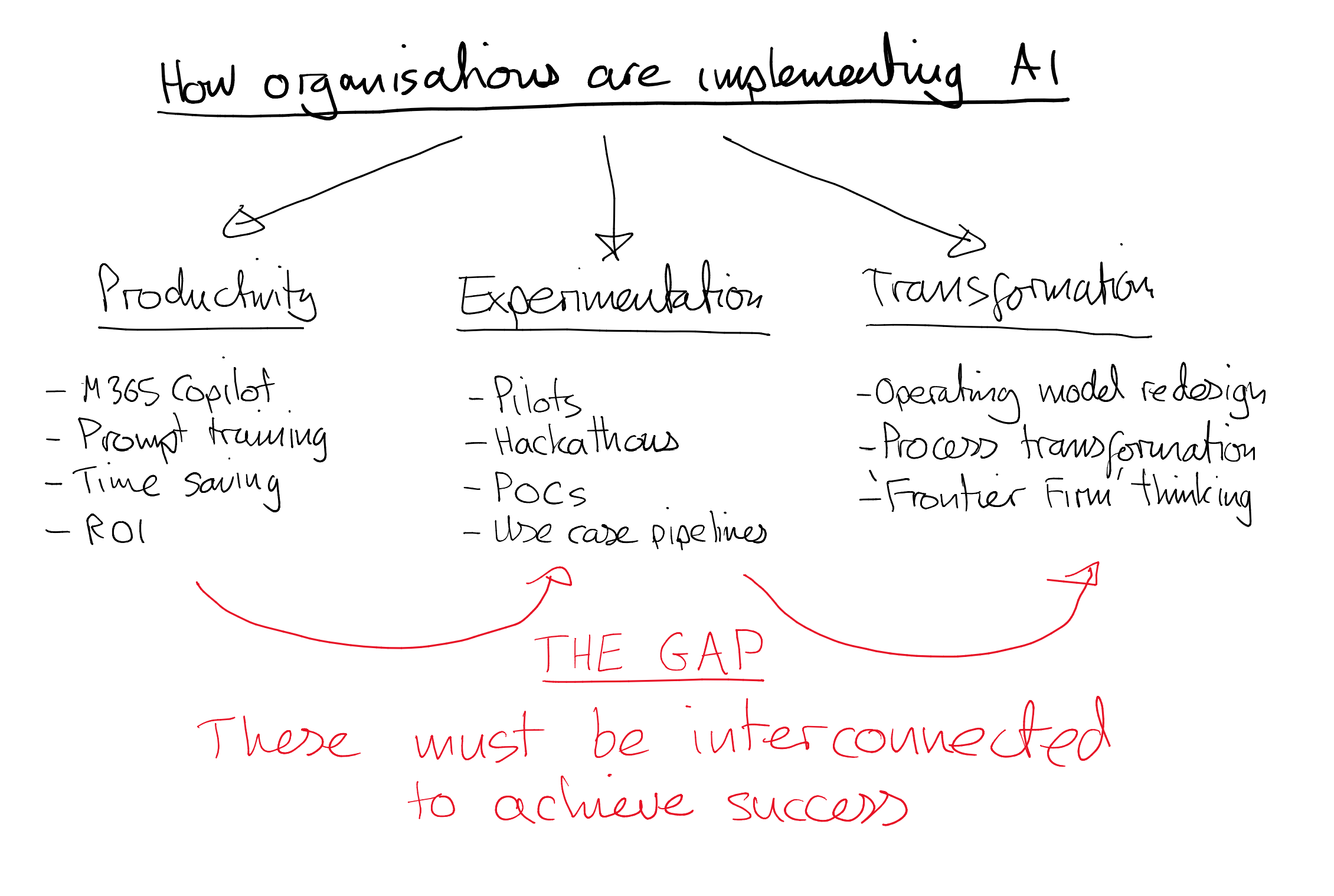
A hand-drawn diagram titled "How Organisations Are Implementing AI" showing three common approaches organisations take towards AI adoption.
The first column, Productivity, focuses on Microsoft 365 Copilot, prompt training, time savings and ROI.
The second column, Experimentation, focuses on pilots, hackathons, proofs of concept and use-case pipelines.
The third column, Transformation, focuses on operating model redesign, process transformation and Frontier Firm thinking.
Red arrows highlight a gap between the three approaches, with the note: "These must be interconnected to achieve success."
Regardless of which route they've taken, most of these initiatives have been led as technology change programmes. The more successful organisations realised early on that they were really dealing with people and organisational change. The most successful are starting to recognise something bigger still: AI isn't simply changing the tools we use. It's changing how organisations need to operate.
The more I thought about this, the more I realised that organisations aren't stuck because of technology. They're stuck because something is missing between individual adoption and enterprise transformation.
I started calling this the missing middle.
The Problem
Organisations, or more specifically people and their objects and goals, are commonly driven by short time frames, measurable results, visible impact, and recognition is given in the moment or in that year’s review, payrise, bonus, and / or promotion cycle - That drives behaviours that focus on being successful within that framework.
That, and the licensing, consumption, and people costs associated with rolling out these new capabilities drive a primary quest for ROI. This is important, of course, but can result in missing the bigger prize of Transformation and the benefits associated with ‘Frontier Firms’ - to “fundamentally change how work happens by giving employees access to expertise, capacity, and capability that previously only existed in the largest organisations'.“
What this means is that organisations are constantly searching for the short term wins without understanding how to move from achieving success in some productivity improvements, or with some experimental use cases, to achieve enterprise transformation at scale and embed it to differentiate themselves against their competitors for the future!
Organisations may then default to what’s easiest to measure… Productivity gains are immediate and time can be measured. Transformation takes years! Because of this many organisations are stuck in this chasm of not knowing or understanding how to move from Individual adoption or experimentation to Enterprise Transformation.
The problem isn't that organisations measure ROI. The problem is that they optimise for the ROI they can see rather than the transformation they ultimately want.

A hand-drawn diagram titled "The ROI Trap" comparing tactical and strategic approaches to AI value measurement.
The tactical side is described as quantitative, easy, quick and focused on immediate results.
The strategic side is described as qualitative, difficult, slower to realise and often recognised retrospectively.
The centre highlights impact, measurement, implementation and recognition.
A key message states: "Deploy AI → Measure savings → Declare success."
A red annotation questions how organisations bridge the gap between individual AI adoption and enterprise transformation.
The Missing Middle
This piece between individual productivity and enterprise transformation is the holy grail that organisations, and technology companies, are all chasing at the moment.
Those of us who have been through large-scale digital and low-code transformations have felt this challenge before. The technology changes, but the pattern feels remarkably familiar. Organisations invest in new capabilities, people discover new ways of working, a burst of enthusiasm follows, and then something interesting happens. Some organisations continue building momentum while others stall.
The more I thought about it, the more I found myself coming back to the same question. If organisations can clearly see the opportunity AI creates, and many are investing significant time, money and energy trying to realise that opportunity, why do so many seem to get stuck part way through the journey?
Some get stuck in productivity. People are using Copilot every day and can point to genuine time savings, yet twelve months later the organisation itself doesn't really look any different. Others get stuck in experimentation. They have innovation portals overflowing with ideas, hackathons generating hundreds of use cases and teams actively exploring opportunities, yet very little of that activity seems to translate into meaningful change at scale.
At the other end of the spectrum are organisations talking about transformation, operating models and Frontier Firms. The ambition is there, but often the connection between that ambition and the people doing the work is missing.
Over time I've become convinced that this challenge has surprisingly little to do with technology.
The technology matters, of course, but technology is rarely the thing creating momentum. What sits between individual productivity and enterprise transformation isn't really a technology gap. It's a capability gap. It's a culture gap. It's a community gap. Ultimately, it's an operating model gap.
It's what I've started thinking about as the Missing Middle. The more I explored it, the more convinced I became that this is where capability, community and operating model change intersect.
When I've seen large-scale change succeed in the past, whether that was digital transformation, low-code adoption or now AI, it rarely happened because somebody deployed a platform. The platform was important, but it wasn't the thing that changed behaviour. What created momentum was helping people understand what was possible, giving them space to explore it, encouraging them to share what they discovered and then connecting those discoveries to something bigger than themselves.
That journey usually begins with capability.

A hand-drawn framework showing the stages connecting individual AI adoption to organisational transformation.
The journey progresses from Individual Capability to Community Learning, then Operating Model, Transformation, and finally Frontier Firm.
Supporting notes explain that capability develops productivity, community learning amplifies and spreads ideas, operating models align people, processes and technology, and transformation enables organisations to prioritise, invest, scale and reinvent.
The visual emphasises that AI is an enabler, while the operating model is the differentiator.
Most organisations naturally start by helping people learn the tools. They build familiarity, confidence and understanding. People begin to see what AI can do well, where it struggles and where it might help them in their own work. What's interesting, though, is that capability is rarely the destination. Capability creates curiosity.
The moment people stop asking "How can AI help me do this task faster?" and start asking "Why are we doing this task this way in the first place?", something shifts. That's when experimentation begins to emerge naturally rather than being mandated from above.
What I've consistently found, however, is that individuals can only take this so far on their own.
Learning is often treated as an individual activity. Somebody attends a course, watches a webinar or experiments with a new tool and becomes a little more knowledgeable. There's nothing wrong with that approach, but it's slow and it doesn't scale particularly well. Communities change the equation completely.
One person discovers something useful and shares it. Others try it, adapt it, improve it and apply it in different contexts. Suddenly learning starts spreading far faster than any training programme could achieve on its own. More importantly, communities make change visible. People stop hearing about possibilities and start seeing them. They see colleagues experimenting, sharing successes, discussing failures and helping one another learn.
Looking back at some of the largest transformation programmes I've been involved in, the thing creating momentum was never the technology. The technology provided the opportunity. The community turned that opportunity into a movement.
And this is where my own thinking has evolved the most.
For years I would probably have described successful transformation programmes as technology change supported by good change management. Looking back now, I think that's too simplistic because it doesn't explain why some organisations seem able to sustain momentum while others gradually stall.
Once people have capability and once communities begin sharing ideas, opportunities start appearing everywhere. Somebody finds a better way of analysing information. Another team redesigns a process. Someone uncovers an opportunity nobody had noticed before. Before long there are more ideas than the organisation knows what to do with.
At first that feels like success. Then it creates an entirely different challenge. The question is no longer how to generate ideas. The question becomes how to harness them.
How do people know where to take an idea? How do they get support turning it into reality? How do leaders decide which opportunities are worth investing in? How do successful experiments become standard practice rather than local successes? How do governance, architecture, security and risk help people move faster rather than becoming reasons not to move at all?
The more I look at those questions, the less they feel like technology questions and the more they feel like questions about how an organisation works, and how we truly empower people to lead with the support of the sponsors, SMEs, and key stakeholders around them.
This is why I increasingly believe AI isn't primarily a technology change. It's an operating model change.
The organisations creating the greatest value aren't necessarily deploying more technology than everybody else. What they seem to be doing differently is building mechanisms that allow learning to become action, action to become outcomes and outcomes to become organisational capability.
That's when transformation starts to become visible. Not when another licence is deployed. Not when another pilot completes. Not when another use case is added to a backlog.
Transformation becomes visible when people start questioning assumptions they've carried for years. When processes are redesigned rather than simply accelerated. When teams become comfortable challenging the status quo because capability, confidence and organisational support already exist to help them do something about it.
Eventually there comes a point where AI stops feeling like an initiative sitting alongside the business and starts feeling like part of the business itself. It becomes woven into how people learn, improve, collaborate and make decisions. The organisation develops the ability to continually identify opportunities and act on them.
That's why I think the Missing Middle matters so much.
Technology on its own doesn't create transformation. Neither does capability in isolation. Neither does strategy.
The organisations making the leap are the ones that find a way to connect capability, community and operating model change together so that each reinforces the others.
That's the bridge between AI adoption and transformation.
And I suspect it's the bridge that many organisations are still trying to build.
The AI Transformation Flywheel
The more I explored this idea of the Missing Middle, the more I realised that the journey from adoption to transformation isn't a straight line.
Most organisations seem to assume that if they keep investing in AI, keep running experiments and keep deploying solutions, transformation will eventually arrive. In reality, that's rarely how it works.
What I've seen repeatedly is that successful organisations build momentum in a very different way. Each success creates capability. Capability creates confidence. Confidence encourages experimentation. Experimentation generates new ideas. Some of those ideas create genuine change and, if that change is visible and celebrated, it inspires the next wave of people to get involved.
Over time, the organisation develops a rhythm. Learning compounds. Confidence grows. Knowledge spreads. Change stops feeling like something being imposed on people and starts feeling like something people are actively contributing to.
That's why I think of this journey as a flywheel.
Not because it's neat framework language, but because every time the wheel turns it gathers a little more momentum than the last time.
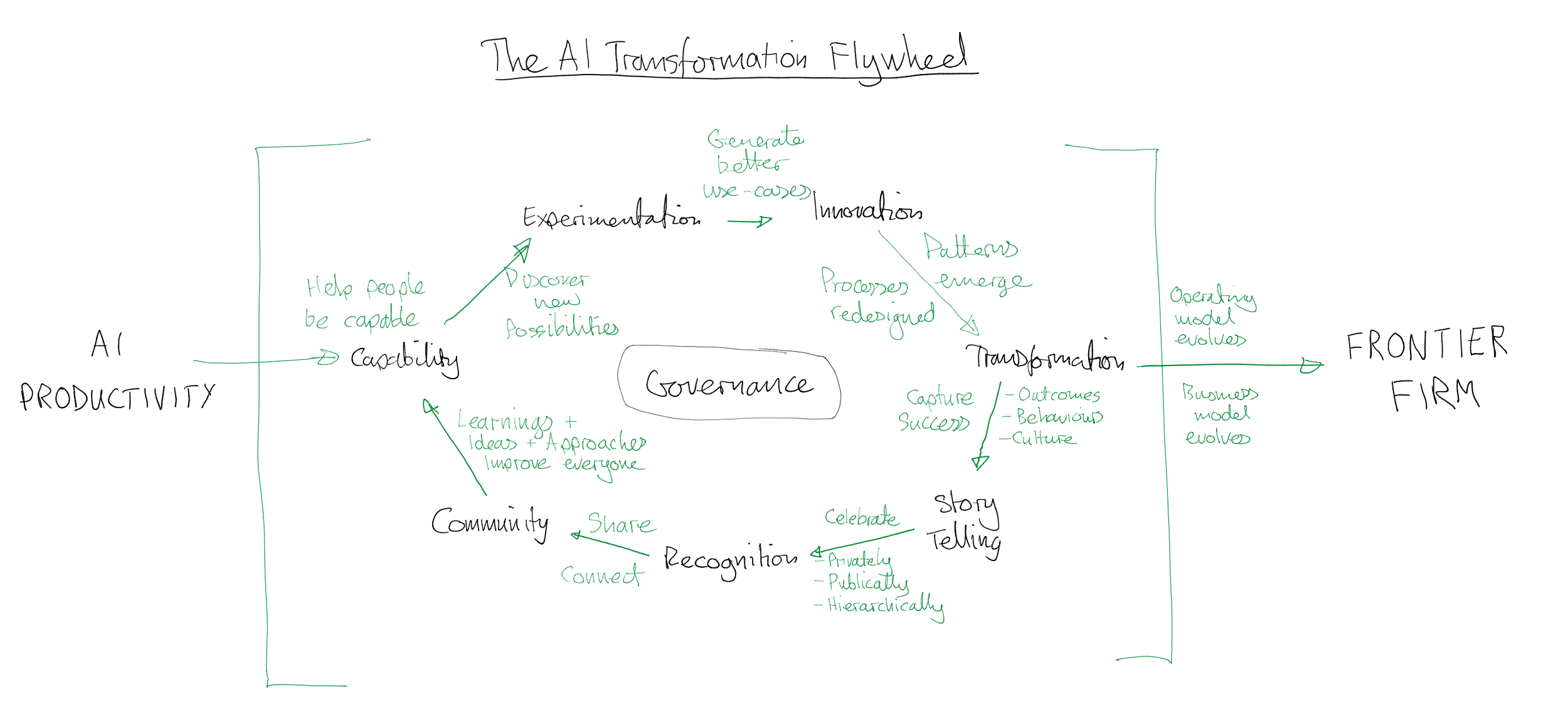
A hand-drawn framework titled "The AI Transformation Flywheel".
The diagram positions AI Productivity as the entry point and Frontier Firm as the outcome.
At the centre is a circular flywheel consisting of: Capability; Experimentation; Innovation; Transformation; Storytelling; Recognition; Community
The cycle shows how capability enables experimentation, experimentation generates innovation, innovation drives transformation, and successful transformation creates stories, recognition and community learning that further improve capability.
Governance sits at the centre of the flywheel, enabling safe scaling and continuous improvement.
The overall message is that organisations become Frontier Firms by continuously converting capability into transformation through a reinforcing cycle of learning and improvement.
At the edge of the flywheel sits productivity. That's where most organisations start. People save time. They automate repetitive tasks. They write documents faster, analyse information more quickly and begin experimenting with different ways of working.
What's easy to miss is that productivity isn't really the destination. It's simply the thing that helps people become more capable.
As that capability grows, curiosity tends to follow. The conversation shifts from "How can AI help me do this task faster?" to "Why are we doing this task this way in the first place?" That's when experimentation begins to emerge naturally rather than being driven through formal innovation programmes.
Most experiments won't work. That's fine. In fact, if none of them fail, we're probably not pushing hard enough. What matters is that some reveal new possibilities. Over time patterns start to emerge. Different teams begin discovering similar opportunities. People stop thinking about individual tasks and start questioning entire processes.
That's where innovation starts to appear and that's where something else interesting happens.
The challenge is no longer generating ideas. There are usually plenty of those by this point. The challenge becomes recognising the ideas that matter, connecting them together and creating the conditions for them to scale.
This is where transformation begins. Not because another tool has been deployed or another project has gone live, but because the organisation starts behaving differently.
Processes are redesigned rather than simply accelerated. Opportunities are identified and acted upon more quickly. Teams become more confident challenging assumptions because they know there is support around them to turn good ideas into action.
The mistake many organisations make is treating transformation as the end of the journey. It isn't.
Successful transformation creates stories. People achieve something new. A team solves a problem differently. A process improves. A customer has a better experience. A colleague discovers a completely new way of working. Those stories matter because they make change visible.
When they're shared well, they create belief. They help people see what's possible. They show that transformation isn't happening somewhere else in the organisation. It's happening here, with people just like them. That visibility creates recognition.
People who experiment, share and challenge assumptions begin to be noticed. Their contributions are celebrated. Others start following their example. Behaviours that once felt unusual gradually become normal.
And that's where communities really start to matter because communities create something no training programme ever can. They create shared learning.
One person's experience becomes everybody's experience. Knowledge spreads faster. Questions get answered more quickly. People build on each other's ideas instead of starting from scratch every time.
Before long, the organisation is no longer relying on a small group of enthusiasts to drive change. It starts learning as a network and when that happens, capability grows again.
The wheel turns. The next cycle starts from a stronger position than the previous one.
The organisation isn't introducing AI anymore. It's continuously improving because of it.
At the centre of all of this sits governance. Not as a gate. Not as a brake. Not as the department that says no.
The organisations that seem to be making the most progress have stopped treating governance as something that prevents change and started treating it as something that enables change safely. Without governance the flywheel creates risk. Without the flywheel, governance creates bureaucracy.
The Outcome: The Frontier Firm
This is why I think many organisations misunderstand the idea of the Frontier Firm.
It's easy to assume that Frontier Firms are simply organisations that have deployed more AI than everyone else but I don't think that's what differentiates them.
You don't become a Frontier Firm because you bought more licences. You don't become one because you built more copilots. You don't become one because you delivered more use cases. The organisations making that leap seem to be doing something fundamentally different.
They're building the capability, culture, community and operating model that allows them to continuously learn, adapt and reinvent themselves. AI is part of the story. The ability to continually transform is the differentiator.
You do not buy a Frontier Firm.
You become one.
