
Impact of AI 04: The Hidden Curriculum
In the last article I explored the idea of the Capability Factory.
The thought was simple enough. Knowledge work does not just create outputs. It also creates people.
When someone researches a topic, builds a presentation, drafts a proposal, supports a workshop, takes meeting notes or prepares analysis, the visible output might be a document, a set of slides, a recommendation or a decision. But there is often another output that is much harder to see. The person doing the work becomes more capable through the act of producing it. That idea has stayed with me because I think it changes how we should think about AI and work.
Most of the current conversation still focuses on whether AI can perform the task. Can AI summarise the meeting? Can it draft the document? Can it review the content? Can it produce the analysis? Can it generate the proposal? Those are useful questions, but I am increasingly convinced they are incomplete ones. The more interesting question may be what the task was really doing. I'm not sure the task was always the point.
A few days after writing about the Capability Factory, I found myself sketching another version of the same idea. At first it looked like a simple pyramid of junior, senior and subject matter expert work. Junior people researching, interviewing, collating information, creating drafts, taking notes and reviewing documents. More experienced people drawing insights, finalising documents, developing proposals, teaching juniors, building business cases and reporting to clients. Senior experts setting direction, critiquing proposals and leading important conversations.
It would be easy to look at that pyramid and conclude that these are simply different tasks performed at different levels of seniority.
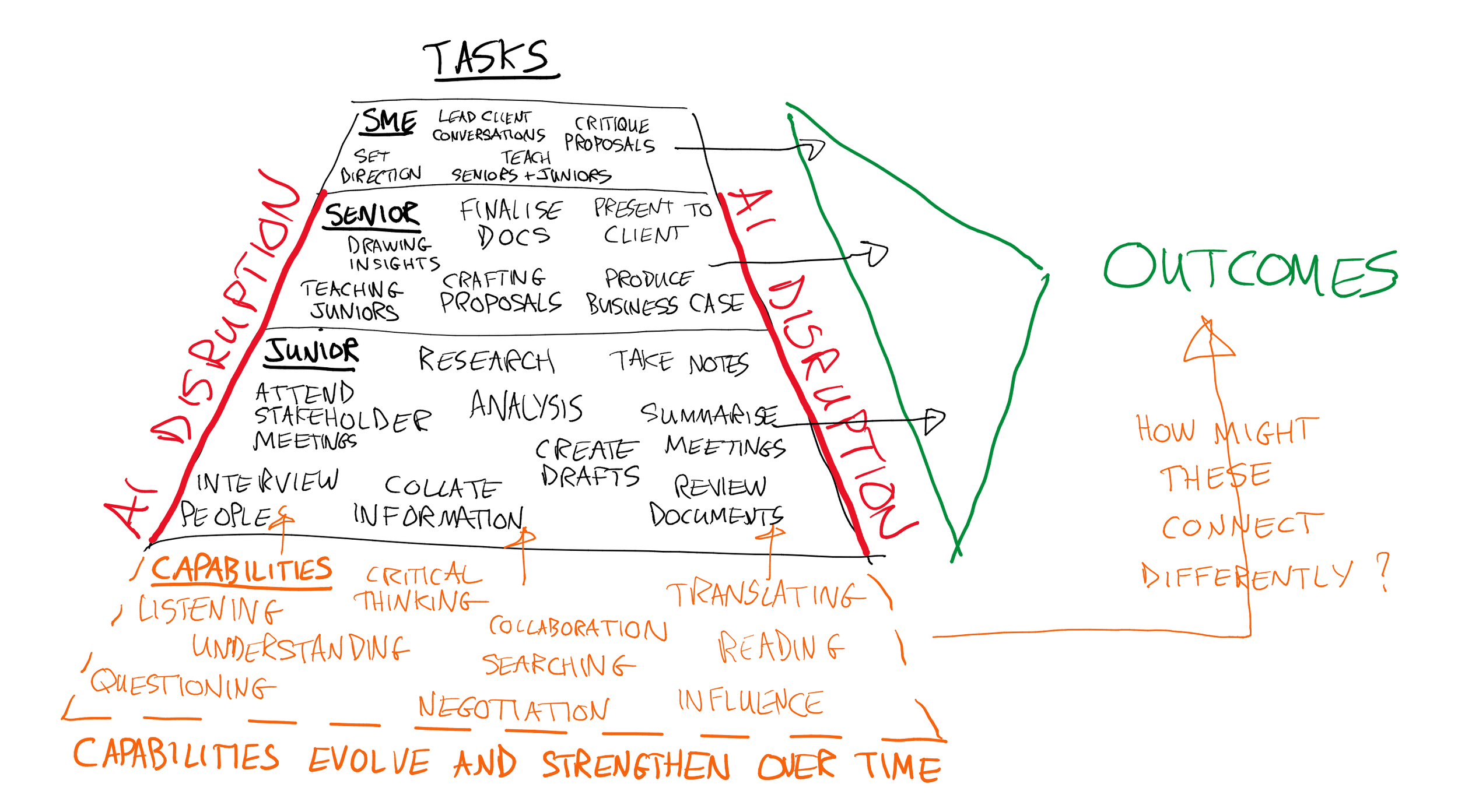
The Hidden Curriculum illustrates how professional development often happens beneath the visible work people perform. The pyramid shows typical tasks performed across junior, senior and SME roles, with AI increasingly disrupting many of those activities. Beneath the task layer sits a less visible capability layer containing skills such as listening, understanding, questioning, critical thinking, searching, collaboration, negotiation, translation, reading and influence. The model suggests that these capabilities are developed through performing tasks, and that capabilities ultimately drive the quality of outputs and the outcomes organisations care about. The diagram challenges the assumption that tasks are the most important part of work and argues that organisations should focus on preserving and intentionally developing the underlying capabilities as AI changes how work is performed.
The more I looked at it, the more I realised something else was happening underneath.
The tasks were visible - The capability development was hidden.
When someone takes notes in a meeting, the visible task is note taking. But the capability being developed might be listening, understanding, synthesis and translation. When someone researches a topic, the visible task is research. But the capability being developed might be questioning, searching, reading, validation and critical thinking. When someone drafts a proposal, the visible task is document creation. But the capability being developed might be structure, persuasion, audience awareness and judgement.
The task is the thing we see - The capability is the thing being exercised.
That distinction feels increasingly important because organisations have spent years treating tasks as proxies for capabilities. We assume that if someone can produce good analysis, they probably have analytical capability. If they can write a strong proposal, they probably understand the problem. If they can lead a workshop, they probably have stakeholder skills. If they can create a convincing business case, they probably understand value, risk and trade-offs.
Sometimes that assumption is fair. Sometimes it is not.
But the point is that the task has become the visible evidence of something deeper. We do not directly observe listening, understanding, critical thinking, translation, influence or judgement very easily. We observe the outputs those capabilities create. That is why this feels like a hidden curriculum.
The official work might be to prepare the deck. The hidden curriculum might be learning how to structure an argument, understand an audience and make a story land.
The official work might be to summarise the meeting. The hidden curriculum might be learning how to listen for what matters, separate decisions from discussion and notice what was not said as much as what was.
The official work might be to research the market. The hidden curriculum might be learning how to frame a question, test a source and recognise signal in noise.
The official work might be to write the recommendation. The hidden curriculum might be learning how to translate messy information into something a decision-maker can act on.
This is where AI makes the conversation more interesting, because AI can now help with all of those official tasks.
It can prepare the deck, but the person using it still needs to understand the story, the audience, the decision and the argument. A weak prompt often creates a weak deck because the missing capability was never slide production. The missing capability was structured thinking.
It can summarise the meeting, but someone still needs to know whether the summary captured the important points, whether the right actions were identified, whether the real tension was missed and whether the output is useful for what happens next. The missing capability was never typing fast enough. It was listening, synthesis and judgement.
It can research the market, but someone still needs to know what question they are trying to answer, which sources to trust, what assumptions are embedded in the response and what evidence would change their mind. The missing capability was never simply finding information. It was questioning, validation and critical thinking.
It can draft the recommendation, but someone still needs to know what decision is being made, what trade-offs matter, what the organisation is capable of absorbing and what will happen if the recommendation is wrong. The missing capability was never producing words on a page. It was translating complexity into action.
That is why I do not think the answer is to preserve every old task. That would be the wrong conclusion.
Some work was inefficient, slow, repetitive and frustrating. Some of it added little value to the individual or the organisation. If AI can remove unnecessary friction, we should let it. I am not nostalgic about tasks that were painful simply because previous generations happened to learn through them. But we should not confuse removing a task with preserving the capability it once developed. That is the bit I think organisations need to become much more deliberate about.
For years we've assumed that Tasks > Outputs > Outcomes
But perhaps the more accurate picture is Capabilities > Tasks > Outputs > Outcomes
The capability layer has always been there… we've just taken it for granted.
Tasks have often acted as an accepted mechanism for getting to outcomes. We ask people to do work because we need outputs, and those outputs contribute to outcomes. Documents support decisions. Analysis informs priorities. Meeting notes create alignment. Proposals win investment. Business cases unlock action.
But underneath that visible chain sits another one. Capabilities shape the quality of tasks. Tasks create outputs. Outputs influence outcomes.
If the capability layer is weak, the task may still be completed, but the outcome may suffer. A document can be produced without understanding. A recommendation can be written without judgement. A meeting can be summarised without recognising what was actually important. A proposal can look polished while failing to answer the question the reader really cares about.
That is not theoretical. I have seen real examples where a junior team member produces a draft document of low quality but does not realise it, because they have not yet learned to ask the questions that sit behind good work.
Who is this for?
What should it give them?
What do they need to know?
What will they do with it?
What is missing?
What would make this useful rather than merely complete?
Those questions are rarely learned through instruction alone. They are developed through exposure, feedback, repetition and experience. Someone produces something, has it challenged, sees why it does not land, improves it, tries again and slowly builds the instinct for what good looks like. That is why the capability layer matters.
It is also why recruitment processes are slightly revealing.
When organisations interview people, they often use competency-based questions. Give me an example of a time when you influenced a difficult stakeholder. Tell me about a situation where you solved a complex problem. Describe a time when you had to work through ambiguity. Explain how you handled conflict, built trust, challenged assumptions or made a difficult decision. In those moments, organisations are not really asking for evidence of tasks. They are asking for evidence of capability.
They want to know whether the person can influence, listen, negotiate, collaborate, think critically, translate complexity, exercise judgement and learn from experience.
The strange thing is that once people are inside organisations, that mindset often fades into the background. We go back to measuring activity, output and outcomes. We look at deliverables, utilisation, milestones, project progress, sales, customer impact, performance ratings and results.
Those things matter, of course they do. But they are often lagging indicators. The capabilities underneath are the leading indicators.
Weak questioning may not show up immediately. Weak listening may not appear in a dashboard. Weak critical thinking may still produce a document that looks acceptable. Weak translation may not be obvious until the recommendation fails to land with the audience. Weak judgement may only become visible when a decision creates consequences months later. By the time the outcome is visible, the capability gap may already have done the damage. That is why this matters in an AI world.
AI is incredibly good at helping us produce outputs. It can draft, summarise, structure, compare, translate, analyse and explain. Used well, it can also help develop capability by providing challenge, examples, feedback and alternative perspectives. A good interaction with AI can improve the quality of someone’s thinking, not just the speed of their output.
But that will not happen by accident.
If AI is used only to accelerate tasks, organisations may get more apparent productivity while weakening the capability development that used to happen through the work. If AI is used as a shortcut around thinking rather than a support for better thinking, then the hidden curriculum starts to disappear.
That feels like the real risk. Not that AI does the task. That may be fine. The risk is that nobody notices what the task was teaching.
This is where I think the conversation needs to shift. Instead of asking only whether AI can do a task, we should also ask what capability that task used to develop, and how that capability will now be developed intentionally.
If AI takes over meeting notes, how do people still learn to listen deeply?
If AI creates first drafts, how do people still learn to structure arguments?
If AI summarises research, how do people still learn to question sources and recognise gaps?
If AI prepares the initial recommendation, how do people still learn to exercise judgement?
The answer may not be to keep the old tasks. It may be to redesign the way people learn.
That could mean more deliberate review of AI-generated outputs. More conversations about why something is good or weak. More mentoring around the questions behind the work. More opportunities for people to critique, compare and improve rather than simply produce. More focus on prompt quality as a reflection of thinking quality. More attention to whether people are using the right tools for the right work, rather than treating all AI use as the same.
It may also mean creating more environments where people can see how others think, not just what they produce. Communities, peer review, mentoring, shared examples and reflective practice may become more important rather than less important, because they make the hidden curriculum visible.
For years, people developed capability because the work made them do so. The tasks forced listening, questioning, reading, searching, translating, negotiating and critical thinking. Those capabilities were developed through repetition and feedback, often without anyone naming them explicitly.
If AI changes the tasks, we can no longer assume that development will happen in the same way. That is not necessarily bad. In fact, it may be an opportunity.
The old hidden curriculum was uneven. Some people had great mentors. Some did not. Some people were stretched in useful ways. Others were left to work it out alone. Some environments created capability deliberately. Others created it by accident. Maybe AI gives us the chance to design better development pathways than the ones we inherited. But only if we notice what needs to be developed.
The thing I keep returning to is that tasks, outputs and outcomes are visible. Capabilities are often hidden. Yet capability is what determines whether future tasks, outputs and outcomes improve.
If knowledge is becoming more accessible, and if AI is changing the work people do, then organisations need to pay much closer attention to that hidden layer. Because the future advantage may not come from preserving old tasks. It may come from understanding the capabilities those tasks developed and finding better ways to build them.
That is where this series keeps leading me. I started by asking what happens if knowledge becomes free. I then found myself questioning whether wisdom is really one thing. That led to the Capability Factory and the idea that work creates people as well as outputs. Now I find myself wondering whether the most important thing hidden inside work was not the task at all. It was the capability the task forced us to practise. And if AI changes the task, every organisation needs to ask a more precise question.
Not just:
What work can we automate?
But:
What capability are we at risk of not developing?
Exploring Human Capability in an AI World
This article is part of an ongoing series exploring how AI may reshape knowledge, expertise, experience, judgement and organisational capability.
✅ Part 1:What If Knowledge Was Free?
✅ Part 2:Information Isn't Knowledge. Knowledge Isn't Wisdom.
✅ Part 3:The Capability Factory.
✅ Part 4:The Hidden Curriculum.
Coming Next: Exploring what happens when AI changes the journey through which expertise, experience and judgement are developed.
About This Series
The first articles in this series explore what may be changing as information and knowledge become increasingly abundant, what remains uniquely valuable, how organisations develop human capability, and the hidden capabilities that work develops along the way.
Future articles will explore the consequences of these changes and the new models that may emerge as a result.
