
What Border Control Taught Me About AI Agent Controls
I had one of those slightly odd moments recently where my brain refused to stay on the thing it was supposed to be doing. I was meant to be thinking about passports, queues, boarding times and whether I had put my liquids in the right bag. Instead, I found myself looking at border control and thinking:
This is actually a pretty good model for AI agent governance.
Which probably says far too much about the way my mind works at the moment. 🫤😁
But the more I thought about it, the more useful the comparison became.
We spend a lot of time talking about AI agents at the moment. What they can do. What they should be allowed to do. Where humans need to be involved. Whether something should be “human in the loop”, “human on the loop”, or fully automated.
Those phrases are useful, but they can also become a bit abstract. They sound precise, but when you start applying them to real business processes, the edges quickly get messy.
And that is what made the airport example interesting to me. At a border, we have already designed several different operating models for essentially the same outcome.
A traveller needs to enter a country. An identity needs to be checked. A decision needs to be made.
The thing that changes is not the purpose of the process. The thing that changes is where the work happens, where the decision sits, and how the human is involved.
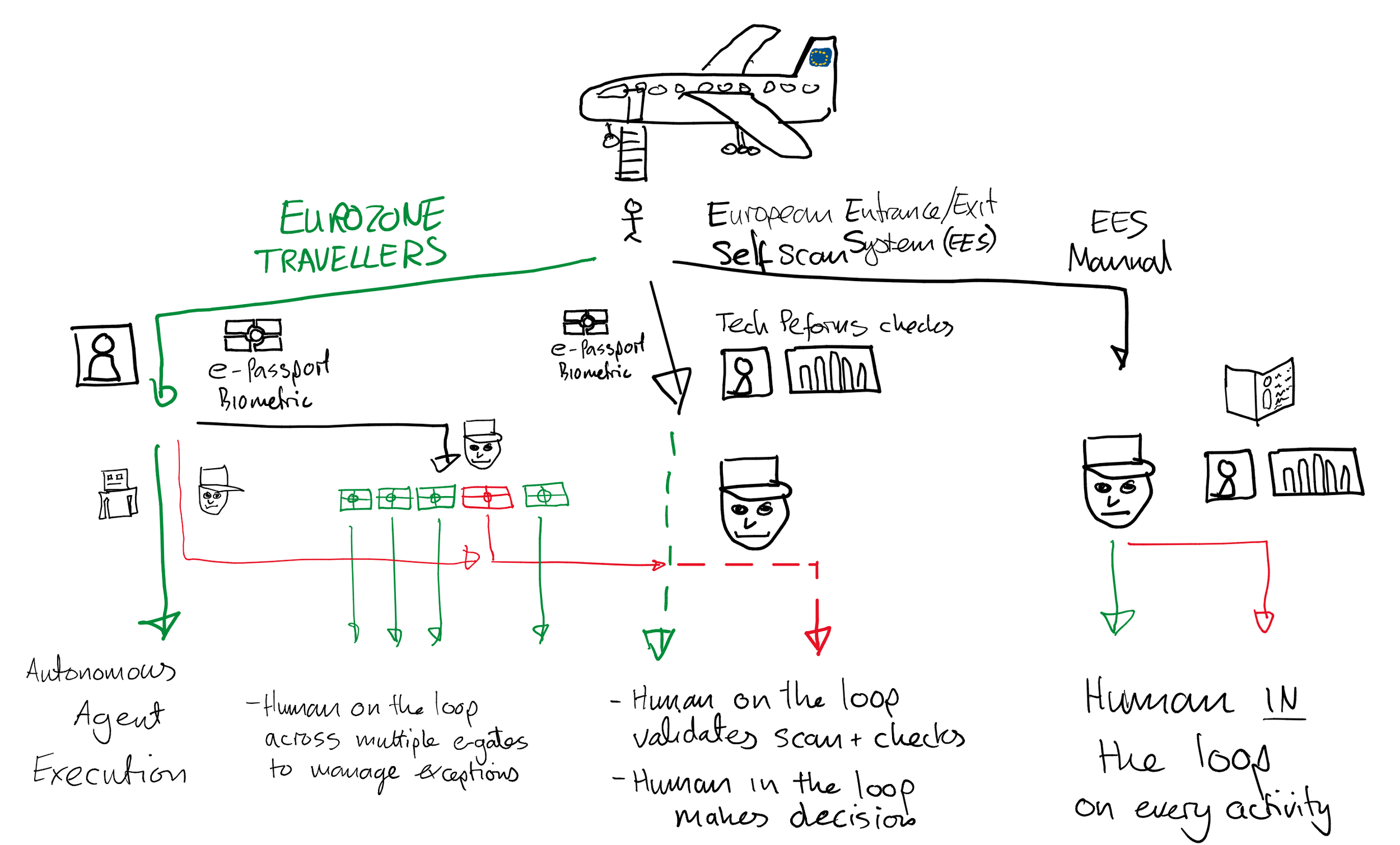
A hand-drawn sketch compares airport border control models with AI agent control models. The image shows three routes for travellers entering Europe, moving from left to right across the page.
On the left, Eurozone travellers use an e-passport biometric e-gate route. Several automated gates are drawn in a row, with most shown in green and one shown in red to indicate an exception or failed path. A human officer is positioned to the side, overseeing multiple e-gates rather than checking every traveller individually. The annotation describes this as autonomous agent execution, with a human on the loop across multiple e-gates to manage exceptions.
In the centre, the European Entry/Exit System (EES) self-scan route is shown. A traveller arrives by plane and moves into a self-scan process where technology performs checks, including passport and biometric validation. A human officer is still involved after the automated checks, validating the scan and making the final decision. The notes describe this as a mixed model: human on the loop validates scan and checks, while human in the loop makes the decision.
On the right, the EES manual route shows a more traditional manual process. A human officer checks the traveller’s documents and biometric information directly, with both successful and exception paths shown. This is labelled as human in the loop on every activity.
The overall image uses green arrows to show standard successful process flows and red arrows to show exception or manual intervention routes. The sketch illustrates that AI agent controls are not simply a binary choice between human involvement and automation. Instead, the level and type of human control changes depending on who performs the checks, who makes the decision, and who oversees exceptions.
The manual route
The traditional version is the one most of us recognise.
You walk up to a border officer. You hand over your passport. The officer looks at the document, looks at you, asks any questions that need to be asked, checks whatever needs to be checked, and then makes a decision.
It is very easy to understand because the human is clearly in control.
The checking, the judgement and the decision all sit with the officer. Every traveller passes through that individual human interaction. The technology may support the process somewhere in the background, but the person is visibly and directly involved in each case.
That feels very similar to the way many organisations still think about controls today. If something is important, sensitive, regulated or risky, a human should review it. A human should approve it. A human should remain directly involved.
And in many cases, that is absolutely right.
There are decisions where we do not want a system to simply decide and act without someone taking responsibility for the judgement being made. Legal reviews. Employee relations decisions. Significant financial approvals. Safety-critical operations. Activities where context, judgement, empathy or accountability really matter.
In those cases, technology may help, but the human remains firmly inside the process. That is the classic “human in the loop” model. Or, in airport terms, it is the manual desk.
The self-scan route
The bit that really made me pause was the self-scan process (and not just because I was waiting for the rest of the family to scan themselves!)
At first glance, it looked like a fairly straightforward step towards automation. The traveller scans the passport. The machine captures biometric information. The technology starts doing some of the work that, in the fully manual version, would have been much more visibly part of the officer’s role.
And my first instinct was to put that neatly into the “human on the loop” bucket.
The system is doing the checking. The human is overseeing. Except, the more I thought about it, the more that did not quite feel right.
Because the border officer has not really stepped away from the process. They are still there. They still look at what has happened. They still have a role in deciding whether the person proceeds. The technology has clearly taken on a meaningful part of the work, but it has not taken over the authority of the process.
That distinction feels important.
The self-scan route is not simply a manual process with a better interface. The technology is genuinely doing something useful. It is capturing information, validating information, comparing information and preparing the case for the next stage. But it is also not the same as an e-gate, where the routine decision is effectively made and executed by the system.
It sits somewhere in the middle and I think that middle ground is where quite a lot of the interesting AI agent conversations will sit for some time.
In many organisations, the first valuable use of agents will not be “let the agent make every decision and take every action”. It will be more nuanced than that. The agent might do a lot of the heavy lifting before a human ever gets involved. It might read the source material, compare it with policy, surface the likely issues, identify the gaps and prepare a recommended course of action. The important point is that the decision has not necessarily moved with the work. The effort may have shifted significantly towards the agent, while the authority still sits with the human.
That is not a weakness in the model. It may be exactly the right model.
There is a lot of value in allowing technology to reduce the burden of checking, comparison and preparation, while still keeping judgement, accountability and final authority with a person. In fact, for many organisations, this may be the model that unlocks the most practical value first. Not because they are lacking ambition, but because the nature of the decision still requires human judgement, even if much of the work around that decision can be transformed.
That was the point where the usual language started to feel a little too blunt.
If we simply ask whether the human is “in the loop”, the answer is technically yes. But that does not tell us very much. A human who performs every check is not playing the same role as a human who validates the output of a system. A human who makes every decision is not playing the same role as a human who only steps in when something is unusual. A human supervising several automated lanes is not doing the same work as a human sitting at a desk reviewing every traveller one by one.
They are all humans in the process, but they are not the same control model.
That, for me, is where the self-scan example becomes useful. It helps expose the difference between the work, the decision and the oversight. Those three things often get bundled together in our conversations about AI, but they do not have to sit in the same place.
Sometimes technology can do more of the work.
Sometimes the human should still make the decision.
Sometimes the human’s role is to oversee the process rather than handle each individual case.
And sometimes, as with the self-scan route, the answer is deliberately mixed.
The e-gate route
The e-gate is different again.
This is the point where the process starts to feel much more like autonomous execution. The traveller presents the passport, the biometric checks happen, and the gate either opens or it does not. For the standard route, the technology is not just preparing information for somebody else to decide. It is performing the checks and acting on the outcome.
However even there, it is not quite as simple as saying the human has disappeared. There is still someone nearby. Usually one officer is watching several gates at once. They are not reviewing every traveller manually, and they are not making every routine decision, but they are still part of the control environment. They help when a scan fails. They ask someone to remove glasses or a hat. They redirect people to a manual route when the automated route is not suitable.
That feels much closer to what I think we often mean, or perhaps should mean, when we talk about autonomous AI agents.
Not an agent operating without boundaries.
Not an agent quietly making decisions with nobody paying attention.
An agent handling the standard path, within a designed control model, with human oversight available for exceptions.
The human role has changed, but it has not vanished.
I think this is an important distinction, because when people hear the word “autonomous”, they often hear “uncontrolled”. But those are not the same thing. An e-gate is highly automated, but it is not uncontrolled. It has a designed flow. It has rules. It has exception handling. It has a route back to manual review when the automated route is not appropriate. It also has someone overseeing the process, even if that person is not involved in every individual transaction.
That feels like a much healthier way to talk about AI agents - Not as systems that replace human responsibility, but as systems that change where human responsibility needs to sit.
The model that started to emerge
The more I looked at the sketch, the more I realised I was not really drawing three different types of border control. I was drawing three different decisions about control.
That sounds obvious when written down, but it was not obvious to me at first. I started with the familiar language. Human in the loop. Human on the loop. Autonomous. Those labels are useful, and I still think they have value, but they can also make us believe we have understood the control model before we really have.
The problem is that a phrase like “human in the loop” can hide a lot of variation.
A human can be in the loop because they are doing all the work. They can be in the loop because they are checking the output of a system. They can be in the loop because they are making the final decision. They can be in the loop because they are watching for exceptions across a wider process.
Those are not the same thing and that was the bit that clicked for me. The question is not simply whether a human is involved. The more useful question is what kind of involvement we actually mean.
In the manual border control route, everything is bundled together. The officer checks the passport, looks at the traveller, considers the situation and makes the decision. The work, the judgement and the authority all sit in the same place.
With the self-scan route, that bundle starts to loosen. The technology has taken on more of the checking and preparation. It is doing something meaningful before the officer becomes fully involved. But the human has not moved away from the decision. The officer still validates what has happened and still has authority over what happens next.
Then, with the e-gate, the bundle loosens again. The system performs the routine checks and acts on the outcome. But the human has not vanished. The human has moved into an oversight role, watching several lanes, stepping in when something does not work, and redirecting people when the automated route is not appropriate.
That is where the airport analogy became more useful to me. It stopped being a simple comparison between three types of border control, and became a way of separating out three things that often get bundled together in business processes: the work, the decision and the oversight.
Who is doing the work?
Who is making the decision?
Who is overseeing the process?
Those questions sound almost too simple, but I think they are useful precisely because they are simple. They force a level of clarity that the labels sometimes avoid.
In an AI agent use case, the agent might take on a lot of the work without taking on the decision. It might gather information, compare evidence, check policy, surface issues and prepare a recommendation. The human may then validate the output and decide what happens next.
In another use case, the agent might handle the standard path itself. It might perform the checks, make a routine decision and complete the action, while a human oversees the wider flow and steps in when something does not fit.
And in another, the right answer may still be that a human stays close to every case, because the context, consequence or sensitivity of the decision demands it.
None of those models are inherently right or wrong. The problem comes when we are not clear which model we are designing.
That is why I found the border control example so helpful. It made the control choices visible. Not in abstract governance language, but in a process most of us have experienced. We know the manual desk feels different from the self-scan process. We know the e-gate feels different again. We instinctively understand that the human role has changed, even though the broad purpose of the process is the same.
And that feels like a much better starting point for AI agent conversations.
Not “is the human in the loop?”
But “what is the human there to do?”
That, for me, is the more interesting question.
Why I think this matters
I suspect a lot of organisations will initially frame AI agent adoption as a choice between two extremes. Either the human does it, or the agent does it but real operating models are rarely that simple.
We do not usually move from fully manual processing to full autonomy in one leap. We create intermediate models. We allow technology to take on more of the checking. Then more of the preparation. Then more of the routine decisioning. Then, in some cases, more of the execution.
The human role does not simply disappear. It moves.
Sometimes the human remains the decision-maker. Sometimes the human becomes the validator. Sometimes the human becomes the supervisor. Sometimes the human is there for exceptions. Sometimes the human should absolutely remain close to every case.
The trick is knowing which model is appropriate for which situation.
That is why I think the airport analogy works. Most people already understand the difference between a manual desk, a self-scan process and an e-gate. They have lived those models. They know that the experience is different. They know that the level of automation is different. They know, instinctively, that the human role is different.
They may just not have thought of it as a governance model before.
A better conversation about AI controls
So I think I will use this analogy again!
Not because it is perfect. Analogies never are but because it makes the control choices visible.
It helps move the conversation away from abstract labels and towards practical design. Where does the work happen? Where does the decision sit? Where does oversight sit? Where do exceptions go? What happens when the automated route is not appropriate?
… and perhaps most importantly, have we understood the loop well enough to decide where the human should be? Because maybe the real question is not whether the human is “in” the loop or “on” the loop. Maybe the real question is whether we have designed the right loop in the first place.
