
Impact of AI 03: The Capability Factory
In the last couple of articles I’ve been exploring a thread that started with a simple question: What if knowledge was free?
At the time, I thought I was writing about AI, consulting and the changing economics of knowledge. But the more I pulled on the thread, the more it became a conversation about people. If information and knowledge become easier to access, then perhaps the more enduring forms of value sit higher up the stack, in expertise, experience, judgement and trust. That was where my previous article landed. I found myself questioning whether “wisdom” is really a single thing, or whether it is actually the combination of expertise, experience and judgement applied in a trusted context. Which led me to another question I haven’t been able to stop thinking about.
If expertise, experience and judgement are where human value sits, where do those things actually come from?
A lot of the current AI conversation focuses on whether AI can replace specific tasks, roles or outputs. Can it write the document? Can it analyse the data? Can it build the presentation? Can it summarise the research? Can it produce the first draft? Those are useful questions, and they matter, but I’m starting to think they are only part of the story.
Because a lot of knowledge work has always had two functions:
It creates value for a customer, stakeholder or organisation.
It also creates capability in the people doing the work.
That second part is easy to overlook because it is rarely the thing being asked for. Nobody commissions a project so that a junior colleague can learn how to structure an argument, identify weak evidence, navigate stakeholder tension or recognise a recurring delivery pattern. The visible output is the document, workshop, analysis, plan or recommendation.
The hidden output is the person becoming more capable through the act of producing it.
When a junior consultant researches a topic, they are not just producing research. They are learning how to search, compare, interpret and separate signal from noise. When someone builds a presentation, they are not just creating slides. They are learning how to simplify complexity, structure a narrative and make an argument land. When someone supports a workshop, drafts a proposal, takes notes, prepares a briefing pack or works through a difficult dataset, they are not simply completing low-value tasks. They are being exposed to how work actually happens.
At the time, some of that work can feel inefficient, repetitive or slightly beneath the level of ambition people have for themselves. In hindsight, it often turns out to have been part of the apprenticeship.
That is what I’ve started thinking of as The Capability Factory.
Consulting is probably the easiest place to see it because the model is so visible. A typical project team contains some form of account leadership, subject matter expertise, experienced practitioners, supporting team members and junior people learning through participation. The customer sees a team delivering value. The organisation delivering the work sees something else happening at the same time: knowledge transfer, experience transfer, capability development, career opportunity and, eventually, the creation of future experts and leaders.
That is not just a staffing model. It is a development system.
Senior people bring knowledge, expertise, experience and judgement into the work. More junior people support delivery, ask questions, make mistakes, receive feedback and gradually begin recognising patterns for themselves. Capability flows down through the organisation, while responsibility, opportunity and future capacity flow upwards.
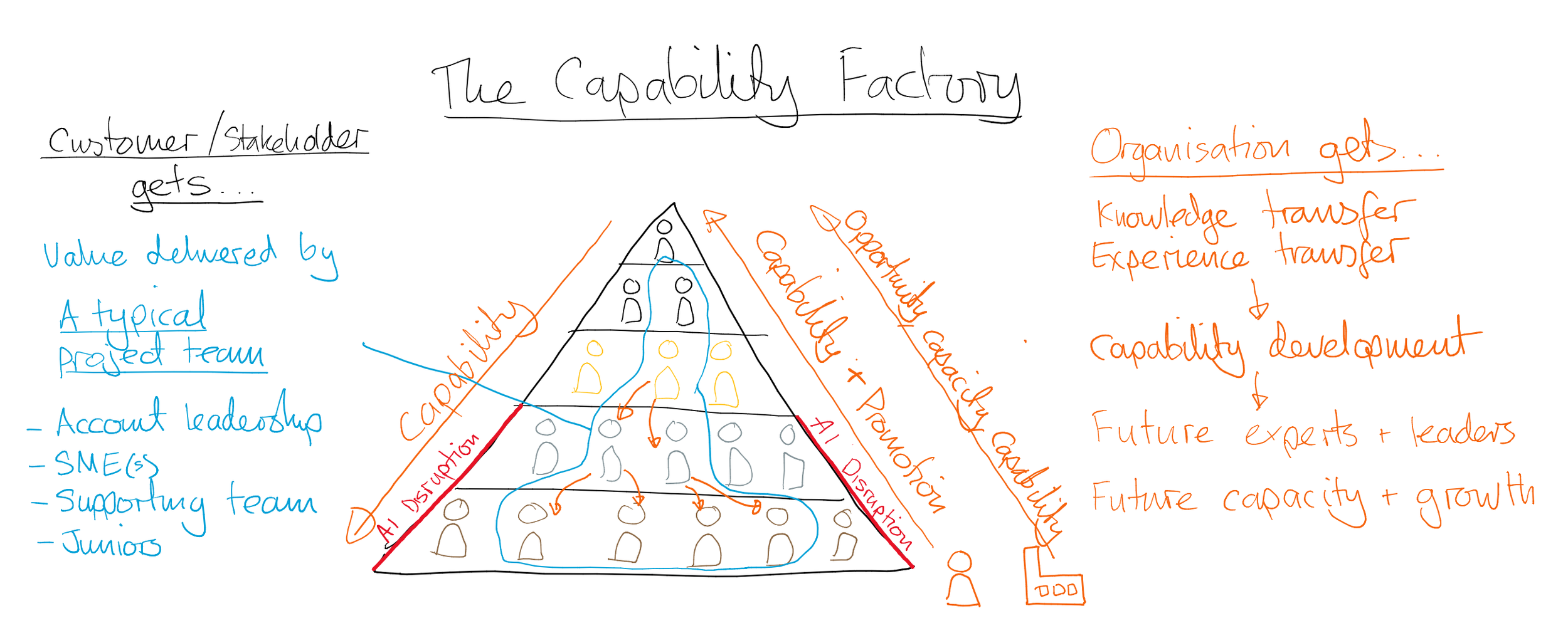
The Capability Factory illustrates how organisations create future expertise, experience and judgement through work. A typical project team delivers value to a customer or stakeholder whilst simultaneously acting as a capability development system. Knowledge and experience flow from more experienced individuals to less experienced colleagues, creating capability development, career opportunities, future experts, future leaders, and ultimately future organisational capacity and growth. The diagram highlights how AI is beginning to disrupt many of the lower-level activities that have traditionally formed part of this development journey, raising the question of how organisations will continue to create expertise if the work people learn from changes significantly.
Once I drew the picture, I realised this is not unique to consulting. The same pattern exists inside organisations too. Internal technology teams work like this. Product teams work like this. Engineering teams, legal teams, finance functions, transformation teams and operational teams all have versions of the same pattern. People learn by working alongside others who are further along the journey. They build capability through exposure to real problems, real constraints, real decisions and real consequences.
That is why the model matters.
Organisations do not create experts through training courses alone. Training helps, but expertise is built through practice. Experience is accumulated through exposure. Judgement develops through repeated encounters with situations where there is not one perfect answer.
Work is the curriculum > Projects are the classroom > Experienced people are the faculty.
That may sound slightly grand, but I think it is closer to reality than many formal learning models. Most of the capability people rely on later in their careers was not built in a classroom. It was built through participation. Through sitting in meetings slightly above their comfort level. Through preparing material for people who knew more than them. Through being challenged on weak thinking. Through watching someone experienced handle a difficult stakeholder conversation. Through seeing an approach fail and understanding why.
This is where AI makes the conversation more complicated.
Many of the activities AI is beginning to accelerate or automate sit in the lower layers of the Capability Factory. Research, analysis, synthesis, documentation, summarisation, meeting notes, first-draft creation, process mapping and project support have often been the work through which people first learned the domain.
Historically, those activities served two purposes.
They created value.
They created people.
From a productivity perspective, AI improving those activities is exciting. I don’t think there is much value in pretending otherwise. Some work is slow, repetitive and unnecessarily burdensome. If AI can reduce the time people spend on genuinely low-value activity, that is a good thing.
But from a capability development perspective, it creates a much more interesting challenge.
If AI performs more of the work that junior people traditionally learned from, what replaces the learning?
That is the question I keep coming back to…
The risk is not simply that AI replaces junior work. The deeper risk is that organisations unintentionally remove or compress some of the developmental experiences that helped people become capable in the first place.
A graduate who no longer needs to research and synthesise information may become productive more quickly, but do they build the same depth of understanding? An analyst who receives AI-generated outputs may move faster, but do they learn how to recognise what is missing? A manager who relies heavily on AI-generated first-pass thinking may get better drafts, but do they still develop the same instinct for what good thinking looks like?
I don’t know the answer but I've seen real examples where a junior team member produces a draft document of low quality but they don't realise it because they didn't stop to ask questions like - Who is this for? What should it give them? What do they need to know? What will they do with it? Those questions are gained through experience.
I don’t think the answer is to preserve inefficient work simply because previous generations happened to learn that way. That would be a strange conclusion to draw from the opportunities AI gives us. But I do think we need to be more deliberate.
There is a difference between removing waste and removing the journey.
Some activities should absolutely disappear. Some tasks are slow, repetitive and add little value to either the individual or the organisation. But other activities that look inefficient on the surface may have been quietly performing an important developmental role. They gave people exposure to complexity. They created space to understand the domain. They built confidence. They developed pattern recognition. They created experiences that later informed judgement.
That distinction feels increasingly important.
If we remove the activity, we should ask whether we have also removed the learning mechanism. If we automate the output, we should ask whether we have preserved the exposure. If we accelerate the work, we should ask whether people still spend enough time with the problem to understand it properly.
This matters because expertise, experience and judgement do not appear suddenly at senior levels. They are developed over time. They emerge through repeated movement from information to knowledge, from knowledge to expertise, from expertise to experience, and from experience to judgement. That journey may not be perfectly linear, but it is real enough to matter. AI can help people move through that journey faster.
Used well, it may become one of the most powerful capability accelerators organisations have ever had. It can explain, challenge, coach, simulate, compare and provide access to knowledge that would previously have been difficult to find. It can give junior people access to perspectives that might otherwise have taken years to encounter.
But that will not happen by accident.
If organisations treat AI purely as a productivity tool, they may weaken the very capabilities they depend on. They may create more documents, more summaries, more analysis and more apparent output, while quietly reducing the exposure that creates future experts and leaders.
I wonder whether the organisations that benefit most from AI won't be the ones that remove the most work. They may be the ones that redesign work so people continue to develop through it.
In other words, if AI changes the factory, we need to redesign the factory.
That is why I think the Capability Factory matters. It gives us a way to look at work not just as output, but as capability creation. A project is not only something to be delivered. It is also an environment in which people learn. A team is not only a delivery mechanism. It is also a development mechanism. A community of practice is not only a place to share knowledge. It is a place where people move from awareness to understanding, from understanding to capability, and from capability to confidence.
Once you view work through that lens, the AI conversation changes.
The question is no longer simply whether AI can do the work.
The question becomes what happens to the people who used to learn by doing it.
I started this series by asking what happens if knowledge becomes free. I then found myself questioning whether wisdom is really one thing. Now I’m wondering whether we have paid enough attention to the machinery that creates expertise in the first place.
The more I think about AI, the less convinced I am that the biggest risk is job replacement.
The bigger risk may be journey replacement.
If AI changes the work people learn from, then every organisation needs to ask a more fundamental question…
What replaces the journey?
Exploring Human Capability in an AI World
This article is part of an ongoing series exploring how AI may reshape knowledge, expertise, experience, judgement and organisational capability.
✅ Part 1:What If Knowledge Was Free?
✅ Part 2:Information Isn't Knowledge. Knowledge Isn't Wisdom.
✅ Part 3:The Capability Factory.
Coming Next: Exploring how AI may impact the development of future experts, leaders and trusted advisors.
About This Series
The first articles in this series explore what may be changing as information and knowledge become increasingly abundant, what remains uniquely valuable, how organisations develop human capability, and the hidden capabilities that work develops along the way.
Future articles will explore the consequences of these changes and the new models that may emerge as a result.
