
Impact of AI 05: Capability Compounds Through Exposure
In the last article, The Hidden Curriculum, I explored the idea that the most important thing hidden inside work might not be the task itself. It might be the capability the task forces us to practise. That thought has stayed with me.
When someone researches a topic, they are not only finding information. They are learning how to question, search, compare, validate and recognise signal in noise. When someone prepares a deck, they are not only creating slides. They are learning how to structure an argument, understand an audience and make a story land. When someone writes a recommendation, they are not only producing words on a page. They are learning how to translate messy information into something another person can act on.
The task is the visible part of the work. The capability underneath is much harder to see. That led me to another question.
If capability is developed through work, how does it develop over time?
At first, the answer felt obvious. People do work, learn from it, become more capable, get trusted with harder things and progress. A junior person becomes more experienced. An experienced person becomes more senior. A senior person becomes a subject matter expert, leader, director, partner or trusted advisor. That is the version we all recognise.
But the more I sketched it out, the more I realised that the interesting thing is not simply that capability grows. The interesting thing is that capability compounds.
A single project rarely changes someone dramatically. One proposal, one workshop, one difficult stakeholder conversation or one failed recommendation might teach a lesson, but it rarely transforms capability on its own.
The transformation happens through repetition. Project after project. Conversation after conversation. Mistake after mistake. Review after review. Moment after moment where someone tries something, receives feedback, sees what happens, adjusts, and carries a slightly better version of themselves into the next situation.
That is how knowledge becomes expertise. It is how expertise becomes experience. It is how experience starts to become judgement.
When I started sketching this out, the first thing I realised was that a project doesn't just create outcomes. It creates capability too.
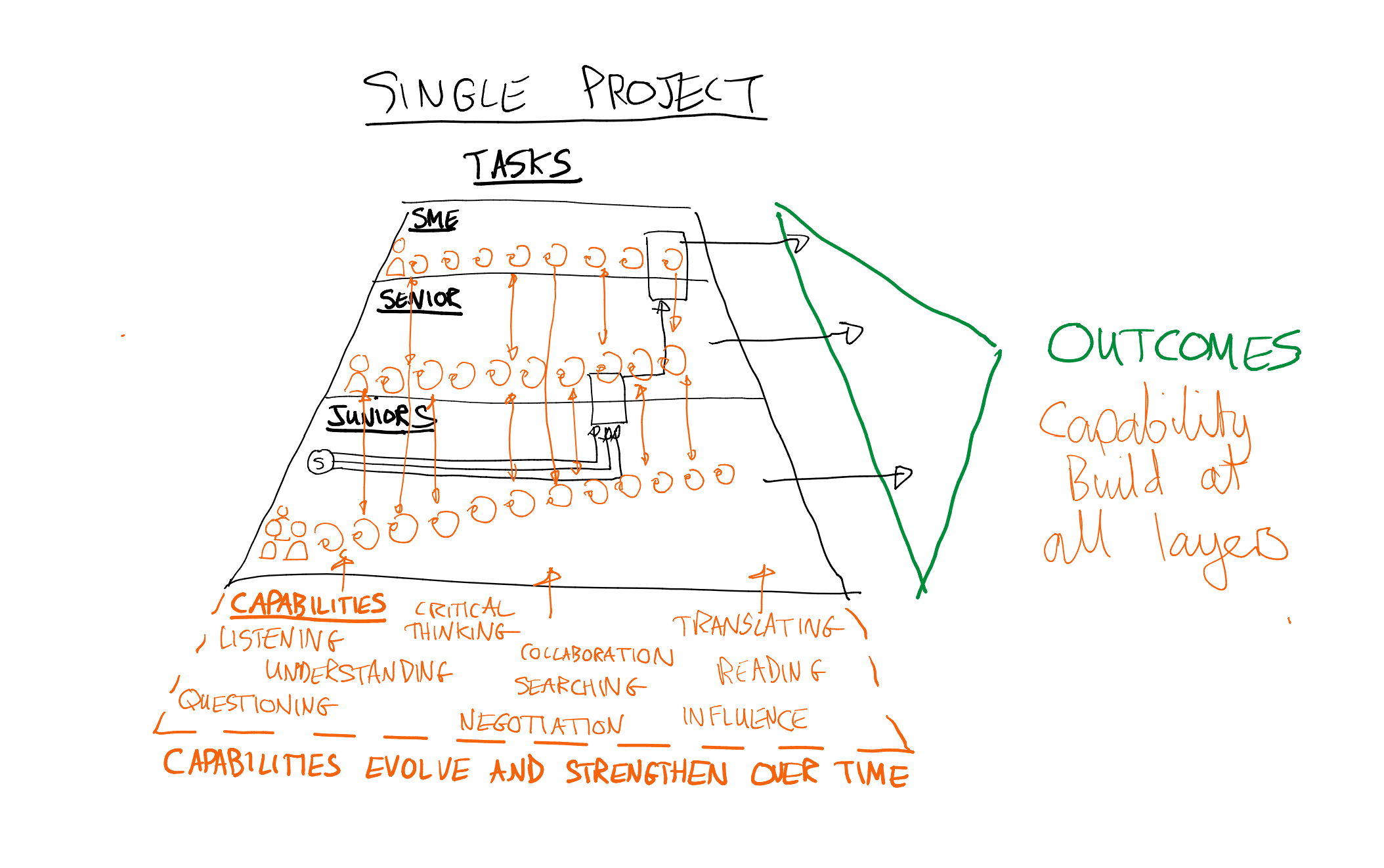
This diagram illustrates how a traditional project creates value in two ways. The visible flow of work produces outputs and outcomes, whilst a parallel flow of interaction, feedback and collaboration develops capability across juniors, seniors and SMEs. Capability is built through participation, observation, challenge and repetition as work moves through the team.
Looking back, I do not think I appreciated this properly earlier in my career. I probably thought progression was mostly about time, opportunity and performance. Do good work, get trusted with harder work, become more senior. There is truth in that, but it misses something important. Progression is often the visible recognition of capability that has been quietly compounding for years.
Looking across multiple projects rather than a single engagement, a different pattern started to emerge. Capability wasn't just developing. It was compounding.
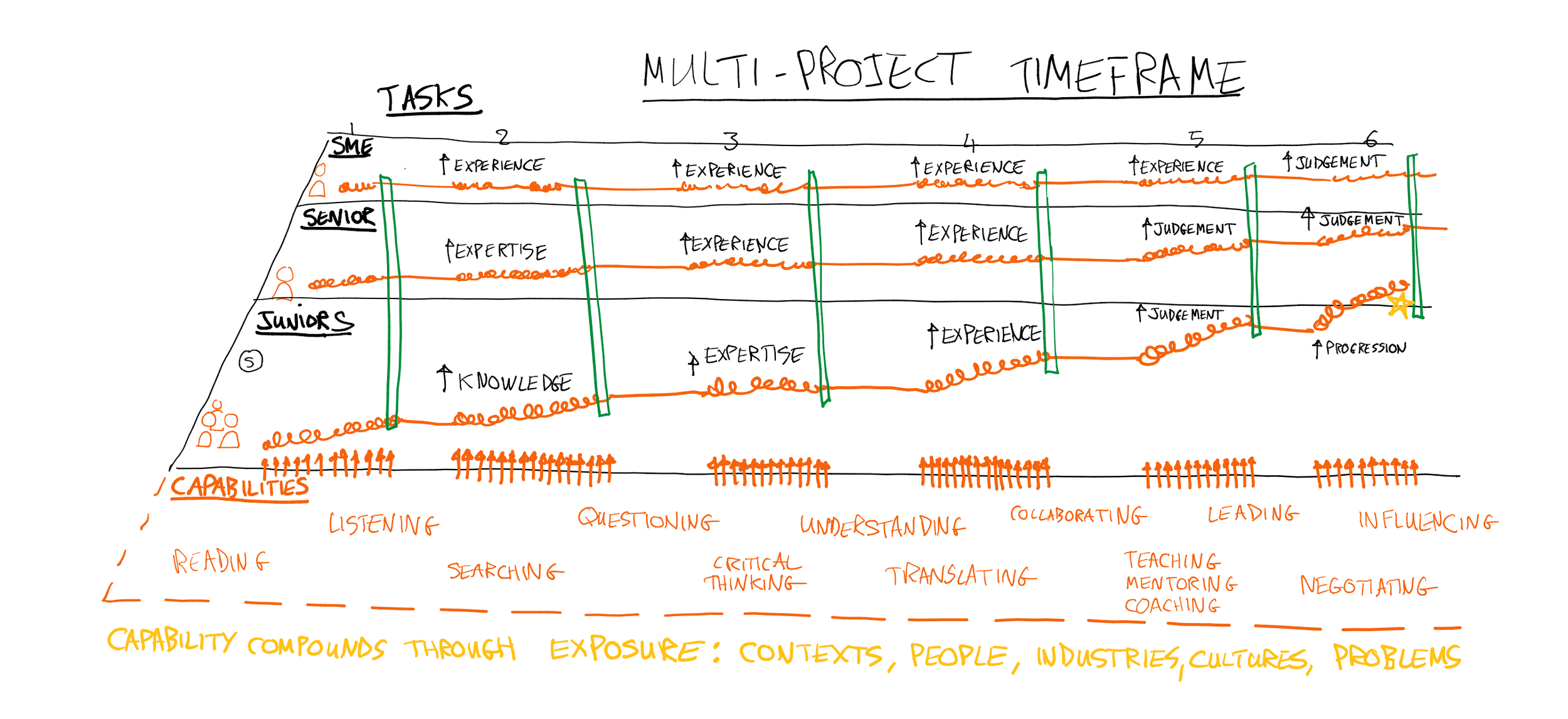
This diagram shows how capability compounds over time across multiple projects. Repeated participation, feedback and exposure gradually transform knowledge into expertise, expertise into experience, and experience into judgement. Progression from junior to senior and SME is shown as the visible outcome of capability compounding. The model also highlights that capability growth is amplified through exposure to different contexts, people, industries, cultures and problems.
The person who appears calm in a difficult meeting is rarely calm because they once attended a stakeholder management course. They have simply seen enough similar situations to recognise the pattern. The person who can sense that a proposal will not land is not guessing. They have seen enough proposals succeed, fail, get challenged, get reshaped and get ignored. The person who knows when not to recommend the technically elegant answer has probably lived through the consequences of doing so at the wrong time, in the wrong organisation, with the wrong people around the table.
Those are not simple knowledge gaps. They are accumulated experience and experience does not build in a straight line. It compounds.
But then I found myself thinking about something else… Capability does not compound equally for everyone.
Two people can spend the same number of years working and emerge very differently. One might become technically strong but narrow. Another might become commercially sharp but weak at developing others. Another might become brilliant at navigating stakeholders but less confident with deep analysis. Another might become very capable inside one organisation but struggle when they move into a different culture, sector or operating model.
Time matters, but time is not enough. The work matters, but the work is not enough either. The environment matters. The people around you matter. The variety of problems matters. The exposure matters.
That is where the picture started to change for me. Capability compounds through exposure. Through different contexts, different people, different industries, different cultures and different problems. Looking back on my own career, I suspect some of the most valuable lessons didn't come from doing more of the same thing. They came from seeing how differently organisations approached similar problems. Different leadership styles. Different constraints. Different cultures. Different assumptions about what good looked like.
Both people are learning. Both people are developing. But they may be developing different kinds of judgement.
That distinction feels important because we often talk about experience as though more experience is automatically better. In reality, the nature of the experience matters enormously. Repeating the same pattern for ten years is not the same as being exposed to ten different patterns over the same period. Depth matters. Breadth matters too. And this is where AI makes the whole thing more complicated.
I then redrew the original project model with AI inserted into the picture. What surprised me was that the outcomes didn't really change very much. The capability pathways did.
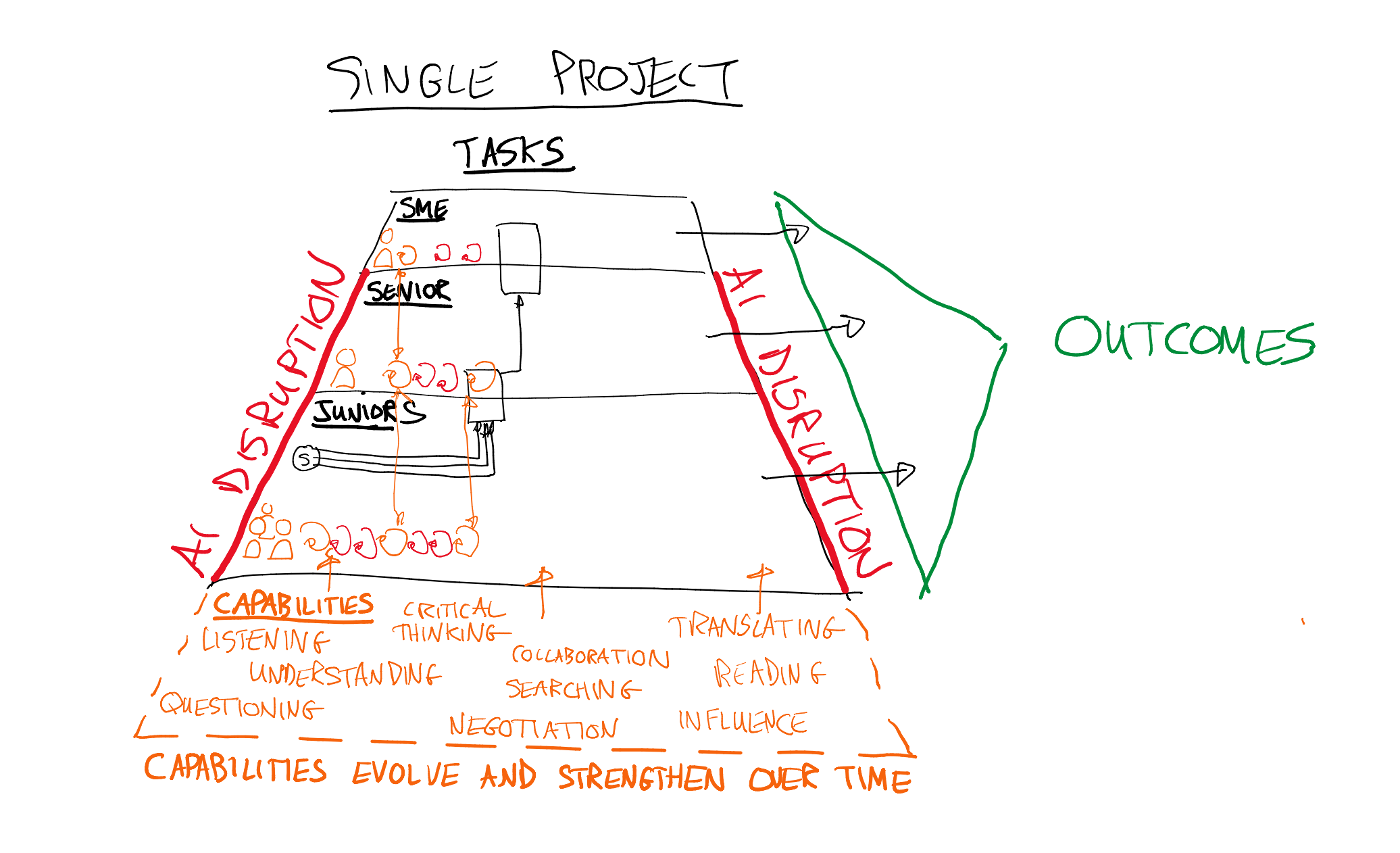
This diagram compares a traditional project with an AI-enabled project. Outcomes remain largely unchanged, but the routes through which capability is developed begin to shift. AI accelerates activities such as information retrieval, exploration, structured thinking and iteration, whilst reducing some traditional opportunities for observation, social learning, apprenticeship and feedback. The diagram raises the question of how capability development changes when AI becomes embedded within the flow of work.
In many ways, AI appears to accelerate capability development. Someone early in their career can now explore more ideas, compare more options, access more information, generate more drafts and iterate faster than I could have imagined when I started working. A junior person can use AI to challenge their thinking, improve their structure, test different framings, summarise complex material and get to a workable first version much more quickly than before. That is exciting! I do not want to lose sight of that.
Used well, AI could become one of the most powerful capability accelerators we have ever had, particularly for individual contribution. It can help with structured thinking, exploration, information retrieval, comparative analysis and iteration. It can make it easier for someone to move from a blank page to something useful. It can give people access to ideas, patterns and perspectives that might previously have required years of accumulated exposure or access to more experienced colleagues.
But not all capability develops in the same way. Some capabilities can be developed through interaction with information. Reading. Searching. Questioning. Understanding. Comparing. Critical thinking. AI can clearly help with those. It can support, challenge, accelerate and expand them.
Other capabilities are different. Collaboration. Teaching. Mentoring. Coaching. Negotiation. Influence. Leadership. Those capabilities are not primarily developed through interaction with information. They are developed through interaction with people.
You cannot really learn how to coach without coaching someone. You cannot really learn how to lead without leading. You cannot really learn how to influence without trying to influence people who may not immediately agree with you. You cannot really learn how to negotiate without experiencing tension, trade-offs, ambiguity and consequence.
Those capabilities require participation in social systems.
They require relationships.
They require feedback loops.
They require exposure to other humans doing unpredictable, inconvenient, brilliant and occasionally frustrating human things.
That is where I think a gap may emerge. Not because AI reduces capability. That is far too simplistic. The more interesting possibility is that AI changes the rate at which different kinds of capability develop. Individual capability may accelerate quickly. Social and leadership capability may not automatically accelerate at the same rate. In some environments, it may even develop more slowly if people have fewer opportunities to observe, practise, struggle, receive feedback and learn through others.
Looking over a longer timeframe, I started wondering whether AI might affect different forms of capability differently.
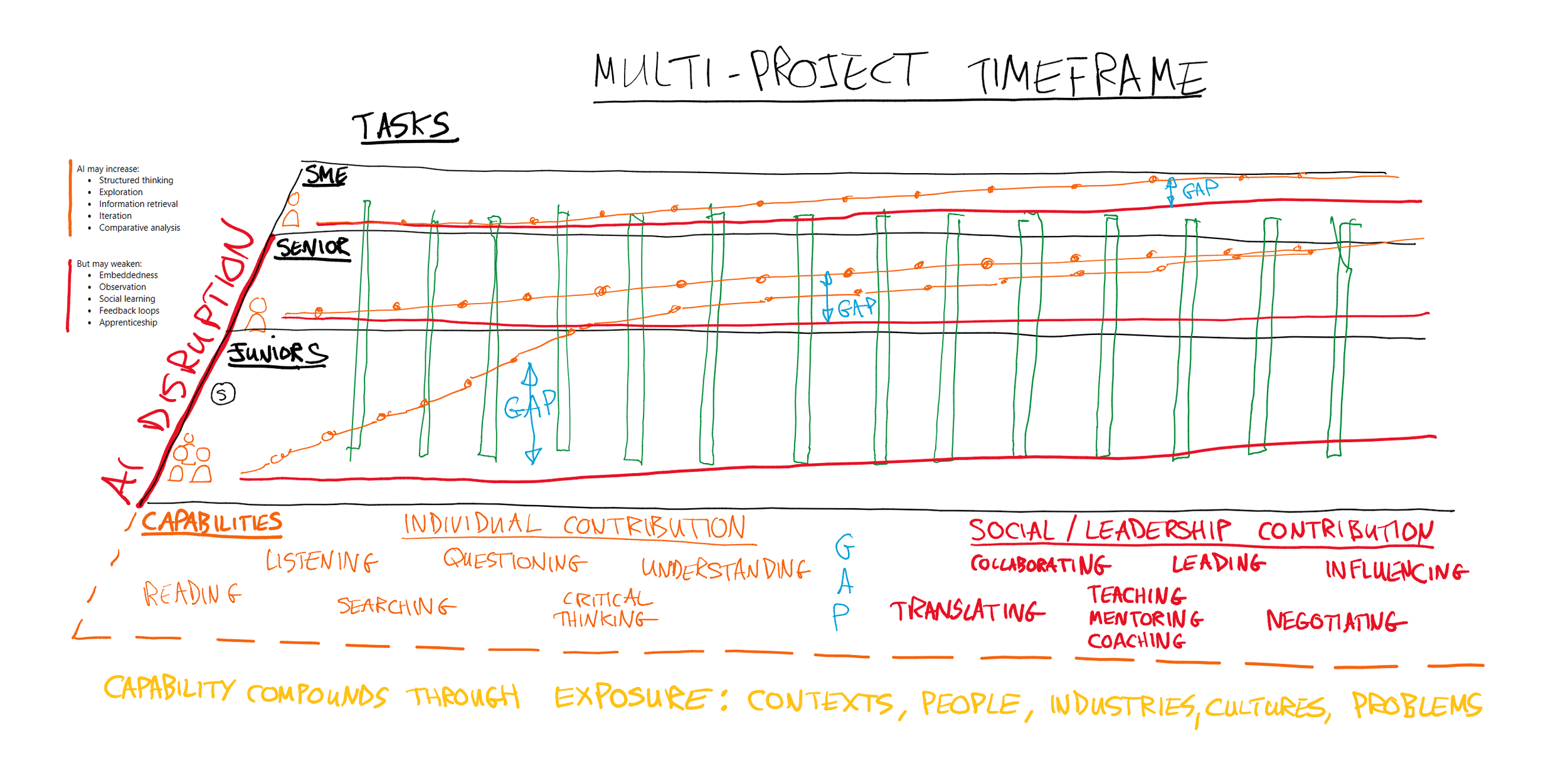
This diagram explores the long-term effects of AI across multiple projects. It suggests that individual capabilities such as questioning, analysis and structured thinking may compound faster with AI support, whilst social and leadership capabilities such as coaching, mentoring, negotiation, influence and leadership may develop more slowly if not intentionally designed for. The highlighted gaps represent the possibility of uneven capability growth over time. The diagram also reinforces the idea that capability and judgement continue to be amplified through exposure to different people, contexts, industries, cultures and problems.
That creates a different kind of risk. The risk is not that people become less capable. The risk is that capability becomes uneven.
We may see people who are exceptional at producing outputs, using AI, analysing information and creating high-quality first drafts, but who have had fewer opportunities to build the social, leadership and judgement capabilities that become more important as they progress. They may become strong individual contributors faster than they become strong developers of other people.
That matters because careers do not stay individual for very long. At some point, most people who progress in organisations are expected to create value through others. They are expected to lead, mentor, coach, negotiate, influence, translate and help other people become more capable. The work shifts from “what can I produce?” to “what can I help others produce?” and eventually to “what kind of environment can I create so others can succeed?”
If AI accelerates the first part of that journey but does not support the second with the same intensity, organisations may create a leadership gap that is not obvious at first. The outputs may look better. The work may be faster. The productivity story may look compelling. But over time the question becomes harder.
Are people developing the capability to lead others, or are they only becoming more effective individual contributors with better tools?
That is not a criticism of AI. It is a design challenge.
The old model was far from perfect. Some people received brilliant mentoring and exposure. Others were left to work things out alone. Some teams created strong development environments. Others simply absorbed people into delivery pressure and hoped capability would emerge along the way.
The old system was not beautifully designed. Much of it was accidental. But it did create exposure.
People saw how experienced colleagues handled situations. They watched difficult conversations. They sat in meetings above their level. They helped prepare work they did not yet fully understand. They saw things fail. They saw things land. They built instinct by repeatedly being close to the work and the people around it.
If AI changes the work, we need to become much more deliberate about preserving, replacing or improving that exposure.
That might mean using AI to accelerate individual learning, but using people, communities and networks to accelerate social learning. It might mean more structured mentoring, more reflective practice, more peer review, more opportunities to observe decision-making, and more spaces where people can see how others think rather than only what they produce.
It may also mean looking beyond the boundaries of a single organisation.
A single organisation can provide projects, mentoring and opportunities to practise. But it can only provide so much exposure. One culture. One operating model. One set of leadership behaviours. One set of assumptions. One version of what good looks like. That can create depth but broader exposure creates something else.
Different organisations show different patterns. Different industries reveal different constraints. Different communities surface different practices. Different cultures create different assumptions. Different problems force different trade-offs. That variety matters because judgement is often built by seeing contrast.
The more I think about this, the more I suspect future capability development may depend on two connected engines.
AI may help people accelerate what they can learn from information.
Human ecosystems may help people accelerate what they can learn from exposure.
Both matter but they are not the same.
If the first four articles in this series were about how AI changes knowledge, human value, work and hidden capability, this one pushes the question a little further. It is no longer just about whether AI changes the task. It is about whether AI changes the way capability compounds over time, and whether different kinds of capability compound at different rates.
I do not think the answer is to avoid AI. Quite the opposite. Used well, AI may help people learn faster than ever before. But if we only focus on faster outputs, we may miss the deeper development question.
What kind of capability is being accelerated?
What kind of capability is being neglected?
What kind of exposure are people receiving?
And what kind of judgement will they be able to exercise in ten years’ time?
I started this series by asking what happens if knowledge becomes free. I then found myself questioning whether wisdom is really one thing. That led to the Capability Factory, the Hidden Curriculum and now this question of how capability compounds.
The more I think about it, the more I suspect the future advantage may not simply belong to people who use AI well.
It may belong to people and organisations that combine AI-accelerated individual capability with rich human exposure, social learning and broader ecosystems of experience.
Capability may compound through practice but judgement compounds through exposure.
Exploring Human Capability in an AI World
This article is part of an ongoing series exploring how AI may reshape knowledge, expertise, experience, judgement and organisational capability.
✅ Part 1:What If Knowledge Was Free?
✅ Part 2:Information Isn't Knowledge. Knowledge Isn't Wisdom.
✅ Part 3:The Capability Factory.
✅ Part 4:The Hidden Curriculum.
✅ Part 5:Capability Compounds Through Exposure.
Coming Next: Exploring how communities, networks and broader capability ecosystems may influence the development of expertise, experience, judgement and leadership in an AI-enabled world.
About This Series
This series began by exploring what happens when information and knowledge become increasingly abundant. It has since examined where human value sits, how capability is developed through work, the hidden curriculum embedded within tasks, and how expertise, experience and judgement compound over time.
Future articles will explore the role that exposure, communities, networks and capability ecosystems may play in developing the next generation of experts, leaders and trusted advisors.
