
Impact of AI 06: Why People Follow
In the last article, Capability Compounds Through Exposure, I explored the idea that capability does not simply grow through repetition. It compounds through exposure.
That thought has stayed with me, partly because it made me think about my own career differently.
When I look back, the people who influenced me most were not always the people with the biggest job titles, the largest teams or the most formal authority. Some had those things, of course, but many did not. Some were architects, specialists, community leaders, change leads, delivery people, managers, consultants or simply the person in the room who seemed to have seen the pattern before everyone else had caught up.
There was something about them that made people listen.
Not always loudly. Not always immediately. Not always because they had the final say.
But when the conversation became difficult, ambiguous or important, people looked towards them. Their opinion carried weight. Their questions changed the direction of the discussion. Their judgement gave others confidence. They could create movement without needing to pull rank.
That is what I have been trying to understand.
Leadership is often talked about as though it begins with a role. A line manager. A director. A partner. An executive. Someone with formal responsibility for people, budgets, decisions or direction.
But some of the most important leadership I have seen has happened outside those reporting lines.
The person shaping technical direction without managing the team. The person helping a community believe something is possible. The person translating a strategy into something people can actually act on. The person trusted enough to challenge a senior stakeholder without the room becoming defensive. The person who spots resistance before it becomes failure. The person who quietly helps everyone else become more capable.
That is leadership too.
And it made me realise that the question changes as we progress through our careers.
Early on, the question is often:
What can I do?
Can I solve the problem? Can I produce the analysis? Can I create the deck? Can I write the recommendation? Can I be trusted with something slightly harder next time?
Then, slowly, the question starts to shift:
What can I help others with?
Can I review the work? Can I explain the concept? Can I coach someone through the problem? Can I help the team avoid a mistake I have made before? Can I make the work better without needing to own all of it myself?
And eventually the question becomes more interesting again:
What capability can I create around me?
That final question feels like the beginning of real leadership to me.
Not leadership as status. Leadership as multiplication. The ability to create direction, confidence, capability and momentum in other people.
That is a very different thing from simply being good at the work yourself.
It is also where credibility and trust start to matter.
As I tried to make sense of that shift, I found myself sketching the journey from individual capability to credibility, trust and the ability to create capability around others.
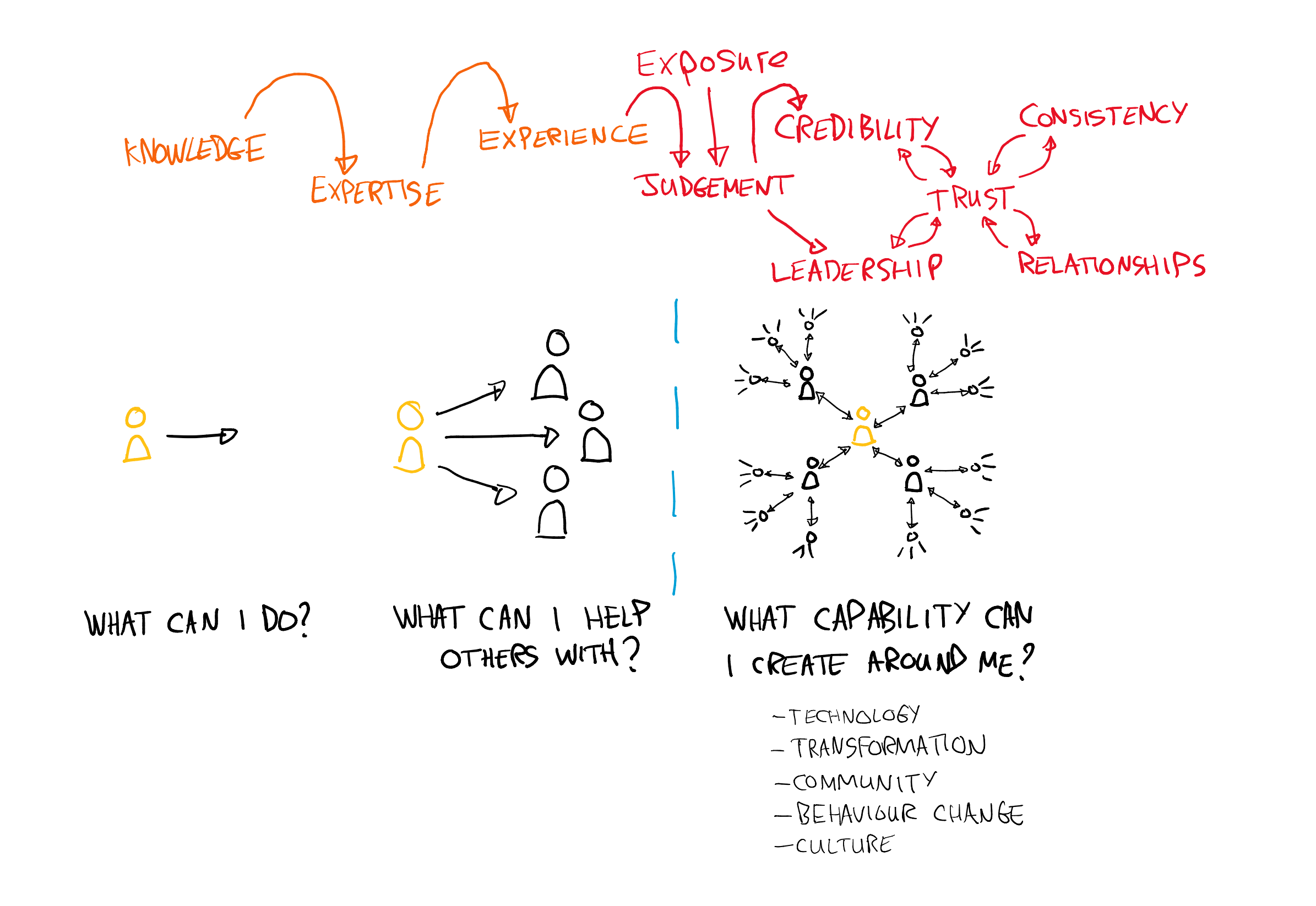
Why People Follow illustrates the journey from individual capability to leadership. The diagram shows how knowledge develops into expertise, experience and judgement, and how judgement helps create credibility. It also highlights that trust is shaped by credibility, consistency and relationships, and that leadership can emerge in many forms, including technology, transformation, community, behavioural change and culture. The model reframes leadership as the ability to create capability, direction and confidence around others, rather than simply holding formal authority.
Credibility is contextual. Different groups grant it for different reasons. A technical team may grant credibility to someone because they have deep expertise, have solved difficult problems before and can spot risks others miss. An executive team may grant credibility to someone because they understand commercial consequence and can connect the detail of the work to strategic decisions. A transformation team may grant credibility to someone because they have lived through enough change to understand the human reality behind the plan. A community may grant credibility to someone because they consistently help, contribute and share what they know without turning everything into a performance.
The point is that credibility does not travel everywhere automatically.
You can be credible in one room and not yet credible in another. You can be deeply respected by practitioners and still not be persuasive with executives. You can be credible with technology specialists and still not be trusted by business stakeholders. You can be known for your expertise and still struggle to create movement because people do not believe you understand their context.
That distinction matters because credibility is not the same as trust.
Credibility says:
I believe you know what you are talking about.
Trust says:
I believe I can rely on you.
They often overlap, but they are not the same thing.
I have worked with highly credible people who were not particularly trusted. They were knowledgeable, experienced and often right, but people hesitated to follow them because they were inconsistent, dismissive, too focused on being right or difficult to work with. The expertise was obvious, but the relationship was weak.
I have also worked with highly trusted people who were not yet credible in a particular domain. People believed in their intent, but when the conversation became technical, strategic or high risk, others still needed more evidence before accepting their judgement.
Leadership needs both.
Credibility without trust can create respect without movement. Trust without credibility can create goodwill without confidence. The people we really follow tend to have a combination of both. We believe they know what they are talking about, and we believe they will use that capability in a way that helps rather than harms the people around them.
That is why I found myself drawing the picture.
Knowledge can become expertise. Expertise, through repeated application, can become experience. Experience, especially when shaped by exposure to different situations, can become judgement. Judgement helps create credibility.
But trust needs something else as well.
Trust is shaped by consistency. It is shaped by relationships. It is shaped by whether people experience us as reliable, fair, generous, useful and honest over time. It is built in small moments that rarely appear on a performance dashboard.
Do we listen when someone raises a concern? Do we follow through after the meeting? Do we help others succeed, or do we use our knowledge to make ourselves look clever? Do we admit when we are wrong? Do people leave an interaction with us feeling more capable or less capable?
Those things matter because leadership is not only about having answers. It is about creating enough confidence in others that they are willing to move, act, learn, change or commit.
That feels especially important in an AI-enabled world.
AI may help people build knowledge faster. It may help them explore unfamiliar topics, structure their thinking, test arguments, prepare recommendations and compare options. Used well, AI may accelerate some of the ingredients that contribute to credibility. Somebody can become more informed, more prepared and more capable of producing useful work more quickly than before.
That is valuable.
But I am much less convinced that AI automatically accelerates trust.
Trust still seems to depend heavily on human interaction. On relationships. On shared experiences. On seeing how someone behaves when the situation is difficult, politically sensitive, ambiguous or inconvenient.
AI can help someone prepare for a difficult conversation, but it cannot have the conversation for them. It can help someone reflect on their communication, but it cannot build the relationship on their behalf. It can suggest coaching questions, but the trust is built in the moment where one person genuinely helps another think, grow or succeed.
That is where the leadership question becomes more complicated.
If AI helps people become more capable individual contributors faster, will it also help them become trusted leaders faster?
Maybe in some ways.
It could help people prepare better. It could help them consider different perspectives. It could offer better examples, better prompts and better ways of framing difficult situations. I do not want to dismiss that, because I think those uses could be extremely valuable.
But leadership is not only about preparation.
It is about participation.
You learn to influence by trying to influence. You learn to coach by coaching. You learn to lead change by being close enough to the people affected by it to understand what is really going on. You learn to build trust by repeatedly acting in ways that others experience as trustworthy.
That requires people.
This article is really asking what happens when capability needs to become influence.
It is the point where value shifts from what we can produce ourselves to what we can help others produce, and eventually to the capability we create around us.
That shift matters for managers, of course, but it also matters for technical leaders, transformation leaders, adoption leaders, community leaders, culture carriers and anyone trying to create movement without relying purely on authority.
Some of the most important leadership in organisations happens in precisely those places where authority is weakest.
The person helping others understand a new technology. The person creating energy around a community. The person connecting teams that were working in isolation. The person translating leadership intent into something practical. The person noticing resistance before it becomes visible in the plan. The person credible enough to be heard and trusted enough to be followed.
Those people create capability around them.
And I am not sure organisations are always deliberate enough about how that kind of capability develops.
We design career paths around roles, responsibilities, outputs and performance measures. We reward delivery. We promote people. We give them bigger teams, bigger budgets, bigger platforms or bigger problems. Then we hope credibility, trust and leadership capability develop along the way.
Sometimes they do.
Sometimes they do not.
The risk in an AI-enabled world is that we may accelerate the early part of the journey without equally accelerating the human experiences that create credibility and trust.
People may become better at producing outputs with AI. They may become faster researchers, sharper analysts, stronger writers and more effective individual contributors. That is useful and valuable.
But if they have fewer opportunities to observe difficult conversations, build relationships, mentor others, resolve tension, influence resistant groups, earn credibility across different audiences and demonstrate consistency over time, then the leadership layer may not develop at the same pace.
At first, that may not be obvious. The work may look better. The outputs may improve. The productivity story may be compelling.
But over time, the harder question appears.
Are people developing the capability to lead others, or are they becoming more effective individual contributors with better tools?
That is not a criticism of AI.
It is a design challenge.
If AI changes how people develop capability, organisations need to become much more deliberate about how people develop credibility, trust and leadership as well. That does not mean sending people on a leadership course once they have already been promoted. By then, some of the most important development opportunities may already have been missed.
Credibility and trust are built long before someone is given a leadership title. They are built through contribution, exposure, judgement, consistency and relationships. They are built when people repeatedly show that they can help others succeed.
That is why I keep coming back to the same thought.
Leadership is not simply a more senior version of expertise.
Expertise helps us do valuable work.
Leadership helps valuable work happen through others.
And that shift depends on credibility and trust.
The more I think about it, the more I suspect the future advantage will not simply belong to people who can use AI to do more. It may belong to people who can use AI to become more capable, while still doing the deeply human work required to help others become capable too.
Because capability may make us effective.
But credibility and trust are why people follow.
Exploring Human Capability in an AI World
This article is part of an ongoing series exploring how AI may reshape knowledge, expertise, experience, judgement, trust and organisational capability.
✅ Part 1:What If Knowledge Was Free?
✅ Part 2:Information Isn't Knowledge. Knowledge Isn't Wisdom.
✅ Part 3:The Capability Factory.
✅ Part 4:The Hidden Curriculum.
✅ Part 5:Capability Compounds Through Exposure.
✅ Part 6:Why People Follow.
Coming Next: Exploring why exposure matters, and how different people, contexts, organisations, industries and problems shape the judgement, credibility and trust that future leaders need.
About This Series
This series began by exploring what happens when information and knowledge become increasingly abundant. It has since examined where human value sits, how capability is developed through work, the hidden curriculum embedded within tasks, how capability compounds through exposure, and why credibility and trust are central to leadership.
Future articles will explore why exposure matters, and how communities, networks and capability ecosystems may help develop the next generation of experts, leaders and trusted advisors.
