
My last blog finished with half a thought - Three options for where an organisation’s judgement actually comes from. Buy it in, borrow the muscle for a while, watch it walk out the door when the contract ends. Build it alone, which is possible, GSK proved that much, but only under conditions most organisations can’t simply decide to have. And then a third thing... something borrowed but not rented, exposure rather than judgement itself... which I said I’d come back to without saying what it actually looks like.
I still haven’t worked out enough of the detail to say it properly.
So this piece isn’t about that third option. It’s about the box I can draw honestly, right now, without pretending I’ve solved something I haven’t. I sketched it out on a whiteboard a few days ago, and it’s stayed pinned up ever since, mostly because it kept being right every time I tried to argue with it.
On the left, a box with a question mark in it. Borrow. Nothing comes out of it yet, nothing goes into it, it just sits there being unresolved, and I’m leaving it that way on purpose.
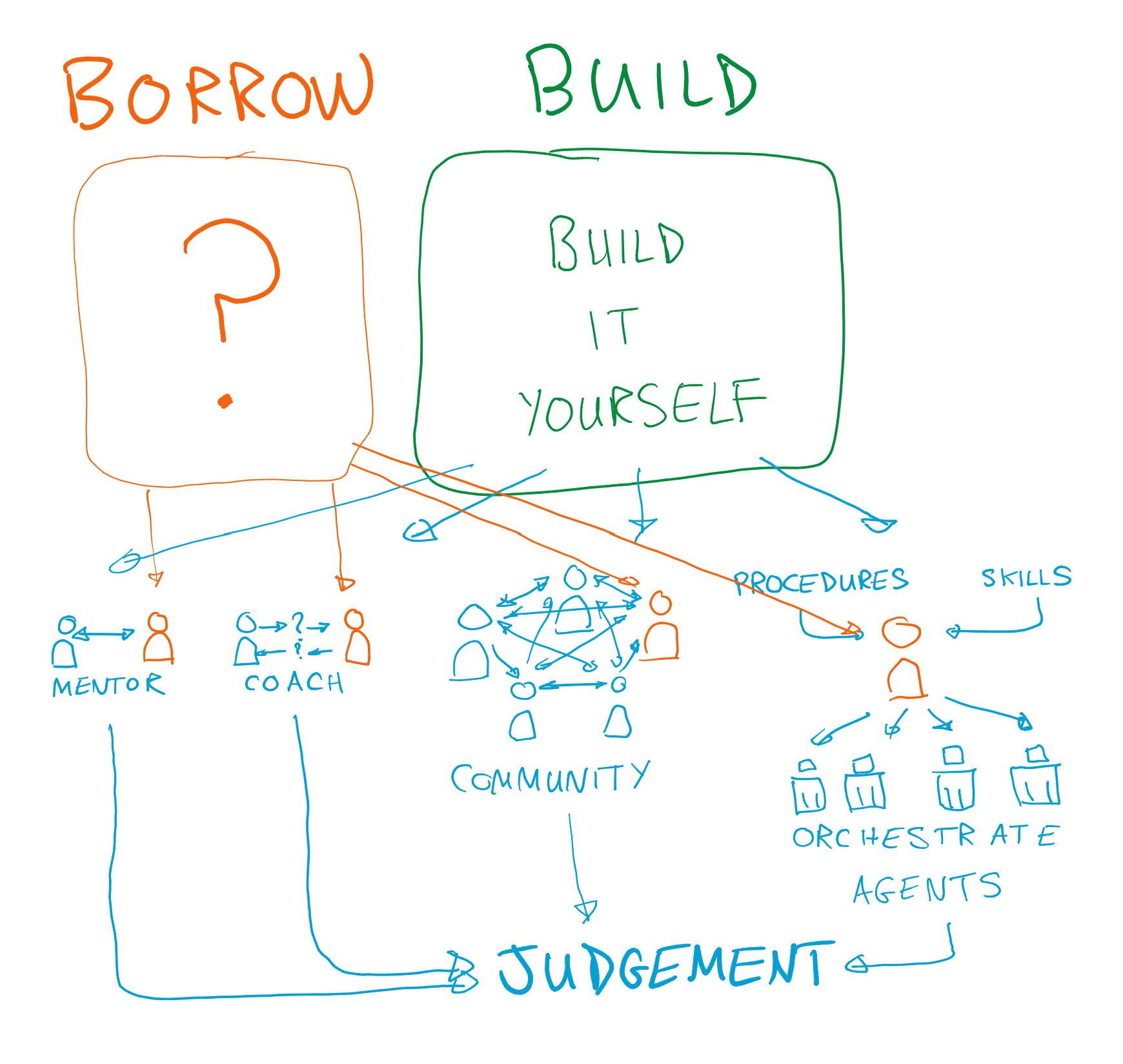
Hand-drawn diagram showing resourcing models of Borrow / Build It Yourself, Mentor, Coach, Community, Orchestrate Agents, all converging on Judgement, with Borrow left deliberately unconnected
On the right, a much busier box. Build It Yourself. And underneath it, four things that actually work.
The first two sit together because they’re easy to confuse and shouldn’t be. A mentor is someone who has encountered some version of the problem before. At their least useful, they hand you the answer. At their best, they let you see the thinking that produced it: the alternatives considered, what was rejected, and which conditions made the eventual decision make sense. That can be useful and fast, although there is still a risk that you inherit someone else’s preference without understanding where it stops being true. A coach does something almost opposite. They don’t begin with their answer. They hand you a better question, and then another one, until you’ve worked your own way to a conclusion you’ll actually trust the next time you’re standing there alone. Mentoring can expose judgement. Coaching helps you exercise it. Organisations tend to buy mentoring and call it development. Coaching is rarer, harder to measure, and probably does more of the real work.
Third is community, and this is the one I find myself thinking about most. Not a hierarchy, not a reporting line, just a tangle of people all pointing arrows at each other, asking, answering, correcting, occasionally arguing. Somewhere inside that tangle sits someone who’s picked up a pattern from outside, a conversation at a conference, a war story from a different sector entirely, and it’s already circulating through the group before anyone’s stopped to ask where it originally came from. Communities absorb things. That’s rather the point of them. I don’t think that quietly blurs the line between build and borrow so much as it reveals that the line was always a bit blurrier than the diagram wants to admit.
Fourth, and this one is new enough that I don’t think anyone’s fully worked out the shape of it yet. Someone stood in the middle, procedures flowing in from one side, skills flowing in from the other, and underneath them four separate agents waiting to be pointed somewhere useful. Orchestrating agents is quickly becoming its own discipline, and it’s worth noticing what that word actually implies. Nobody’s asking whether the agents can do the task. They mostly can. The question is who decides which agent gets which piece of it, when to trust the output and when to override it, when four fast answers add up to one good decision and when they just add up to four fast mistakes. That’s not a technical skill. That’s judgement, applied to machinery rather than to people.
All four of them, mentor, coach, community, orchestration, land in the same place. I’ve drawn arrows from each one down to a single word at the bottom of the page, and every time I’ve tried to draw a fifth destination, a second box, some parallel outcome that isn’t judgement, I’ve ended up rubbing it out again. There isn’t one. Knowledge, skills, procedures, all of it exists to feed something else. The something else is judgement. Everything upstream of that word is plumbing.
There is a condition hidden across all four, though. None of them builds much judgement if people only see the answer. The thinking has to become visible too: the routes considered, the options rejected, the assumptions made and the conditions that changed the decision. That means working out loud, not simply presenting the polished result once the uncertainty has been removed. Exposure matters, but exposure to someone’s conclusion is not the same as exposure to the judgement that produced it.
That is partly why I still draw these ideas by hand. A polished diagram can make an evolving thought look settled. A rough drawing leaves room to point at something, challenge it, move a line and say, ‘I don’t think that belongs there.’ The drawing is not the answer. It is an invitation into the thinking that might eventually produce one.
Which makes me wonder about something I keep seeing described as a hiring problem.
More than one person building these embedded-engineer teams has started describing the demand rather differently lately... not as evidence that judgement is scarce and needs importing, but as evidence that the workflow around the work was never properly built in the first place. That’s a genuinely different diagnosis. A hiring problem gets solved by hiring. A missing system gets solved by building the system, and no amount of hiring quietly fixes that for you, it just delays you noticing.
I think that’s what this picture is actually arguing. Not that mentoring, coaching, community and orchestration are four nice-to-haves you bolt onto a transformation programme once the important work is done. They’re the machine. Judgement isn’t something that shows up because you hired someone impressive or bought an expensive licence, it’s the output of a system that either exists deliberately or doesn’t exist at all, in which case it happens by accident, unevenly, the way it always used to before anyone thought to design it on purpose.
Owning that system does not mean building every component alone. An organisation can bring in mentors, coaches, partners, communities and external expertise. It can borrow experience without permanently renting every decision. What it cannot outsource is responsibility for how those contributions become part of its own capability. The expertise may come from outside. The judgement, learning and ability to continue must increasingly remain inside.
Capability can be built with others without being owned by others.
That’s most of what I have to say today. The box with the question mark in it is still going to be a question mark next time I write. I’m not being cryptic about it, I genuinely haven’t worked out enough of the detail yet, and dressing it up before I have would be worse than just leaving it blank.
What I do want to leave you with is a slightly uncomfortable question, because I think it’s the one that actually matters next. Say you’ve built all four of these properly: mentoring that exposes the thinking rather than only the answer, coaching that’s more than a euphemism, a community people actually learn through, and someone competent orchestrating your agents. Fine. How would you know? Not ‘does it feel like it’s working’, which is what most organisations currently rely on, but something closer to evidence. Is judgement improving? Is it spreading? Are decisions becoming more reliable? Is capability surviving after an external expert leaves? Which experiences, relationships and artefacts are actually making the difference?
This matters because organisations tend to calculate the visible return from the thing that was delivered and ignore the hidden return from becoming more capable while delivering it. Yet that hidden value may determine how quickly the next problem is solved, how much outside help is needed, and whether the organisation can adapt when the conditions change.
That’s where I’m going next!
