
Impact of AI 09 - Where Will Tomorrow's Wisdom Come From?
I keep coming back to a sketch I drew that started with three words. Build it yourself. That was meant to be the answer to something I’ve been circling since the last article, which is what an organisation is actually supposed to do if it wants better judgement and can’t simply buy it in or borrow it for the length of a contract. Build it yourself sounds straightforward until you try to turn it into an instruction. Build what, exactly. How much of it. Where in the organisation does it need to sit. Three questions, and none of them have an obvious answer, because most organisations have never had to answer them properly before. They’ve hired for it, trained for it a bit, and hoped the rest would sort itself out through experience. That’s fine when the world changes slowly enough for experience to keep up. I’m no longer sure it is.
So I did what I usually do and drew two boxes. What capabilities do I need. What capabilities do I have. And then a gap sitting between them, because that’s obviously where the interesting problem lives. What surprised me wasn’t the gap itself, it was how hard the first box turned out to be on its own. Most organisations can tell you what capability they have today, more or less, if you give them long enough to go looking for it. Almost none of them can tell you with any confidence what capability they’re actually going to need, because that question doesn’t come from a skills matrix. It comes from somewhere higher up. From a North Star, a vision, a mission, a strategy, and the initiatives that strategy generates over several different time horizons at once. That’s the bit that gets skipped. People reach for the capability question before they’ve properly answered the direction question, and then wonder why the resulting list of skills feels arbitrary.
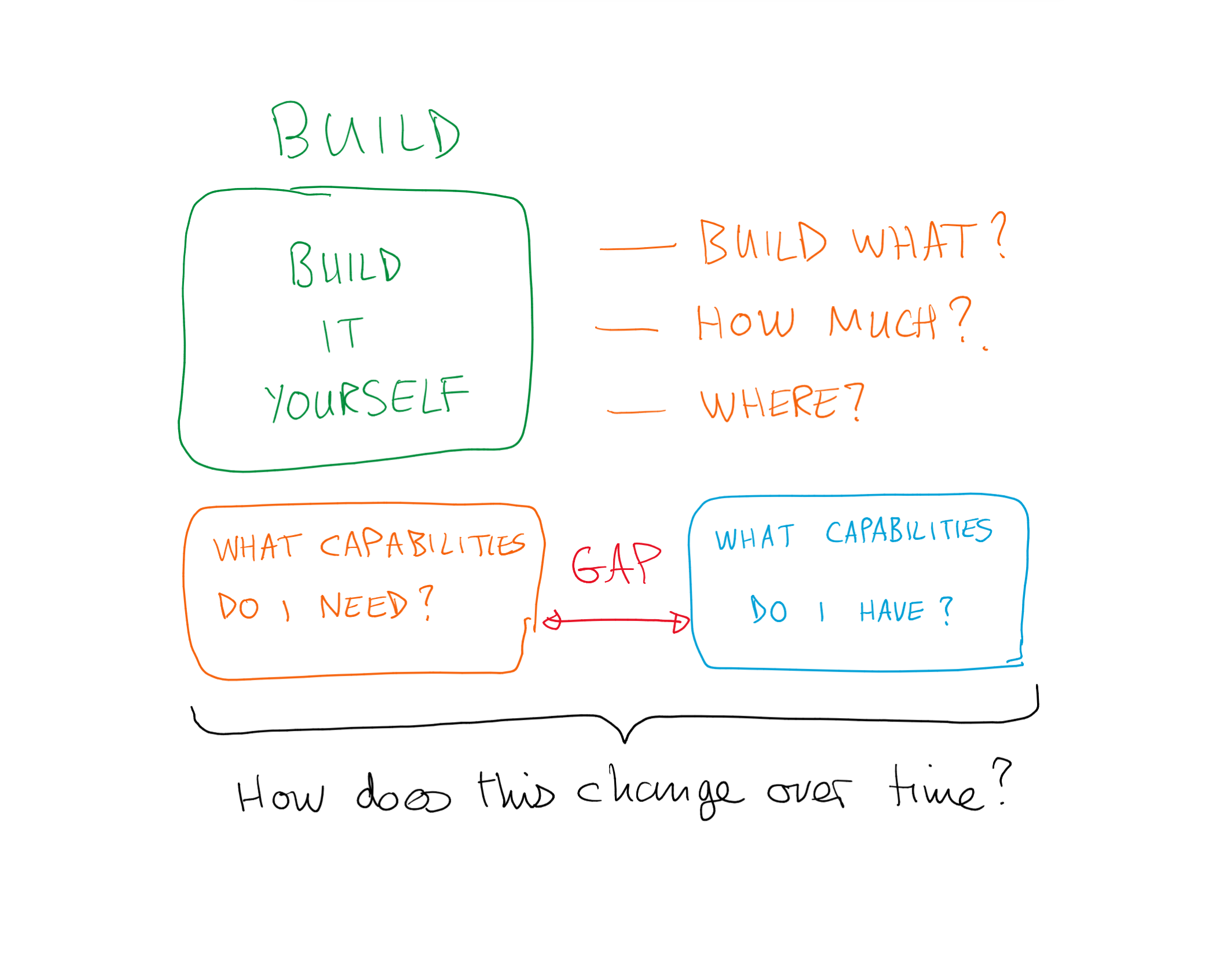
The Build It Yourself sketch: three unanswered questions, the capability gap, and the question of how it changes over time.
That’s what pushed me toward the second sketch, which took a lot longer to sit still on the page than the first one did. I was trying to work out how an organisation actually gets from noticing something is changing in the world to a person, or a group of people, making a good call about what to do next. I ended up with four columns. Data, information, knowledge, wisdom. Nothing new in the labels. What mattered was what I wrote in between them, because that’s where the actual work happens. Between data and information, I wrote context. Between information and knowledge, structure. Between knowledge and wisdom, application. Three words, and I think they quietly explain why so much capability investment stalls one column short of where it needs to.
Data, in that sketch, is just the raw material. Data points and data sources, sure, but also the signals nobody officially labels as data because they don’t arrive as a spreadsheet. Signals about the future. Market signals. Technology signals. Signals about people and culture, which are usually the messiest and the most ignored. None of that means anything on its own, which is why context matters so much at that first transition. Information is what you get once you’ve asked what’s actually changing and, more importantly, what it means for your organisation and your people specifically. Not what’s changing in the world in general. What it means for us, here, given what we’re trying to do. Most organisations are reasonably competent at this. It’s the next transition where things get interesting.
Structure is what turns information into knowledge, and this is where I think most organisational capability effort actually concentrates, whether people realise it or not. It’s mapping what’s changing back onto organisational need. Writing the policy. Building the procedure. Filling the knowledge repository. Designing the training path, the plan, the course. Doing strategic workforce planning so the organisation isn’t caught out. Building community, understanding behaviours, understanding relationships. All genuinely valuable work, and I don’t want to undersell it, because an organisation that skips this layer is chaotic in a different and worse way. But notice what all of that has in common. It’s still describing. It’s still organising. It hasn’t yet had to do anything difficult with a real situation, in real time, with real consequences attached.
That’s what the fourth column is for, and it’s the one I found hardest to describe, which is probably the point. Wisdom, in my sketch, isn’t about what you know. It’s what, why, when, how, where, who. It’s the questions you can only answer once you’re actually in the situation rather than reading about it beforehand. It’s leadership, judgement, collaboration, flexibility, the willingness to help someone else get it right, the evaluation of what just happened, and then the actual execution. And crucially, in my sketch, there’s an arrow running back from that column all the way to the North Star, vision, mission and strategy I started with. Wisdom isn’t the end of the line. It’s supposed to feed back into strategy, because the whole point of exercising judgement well is that the organisation learns something from having done it, and that learning should change what it decides to do next.
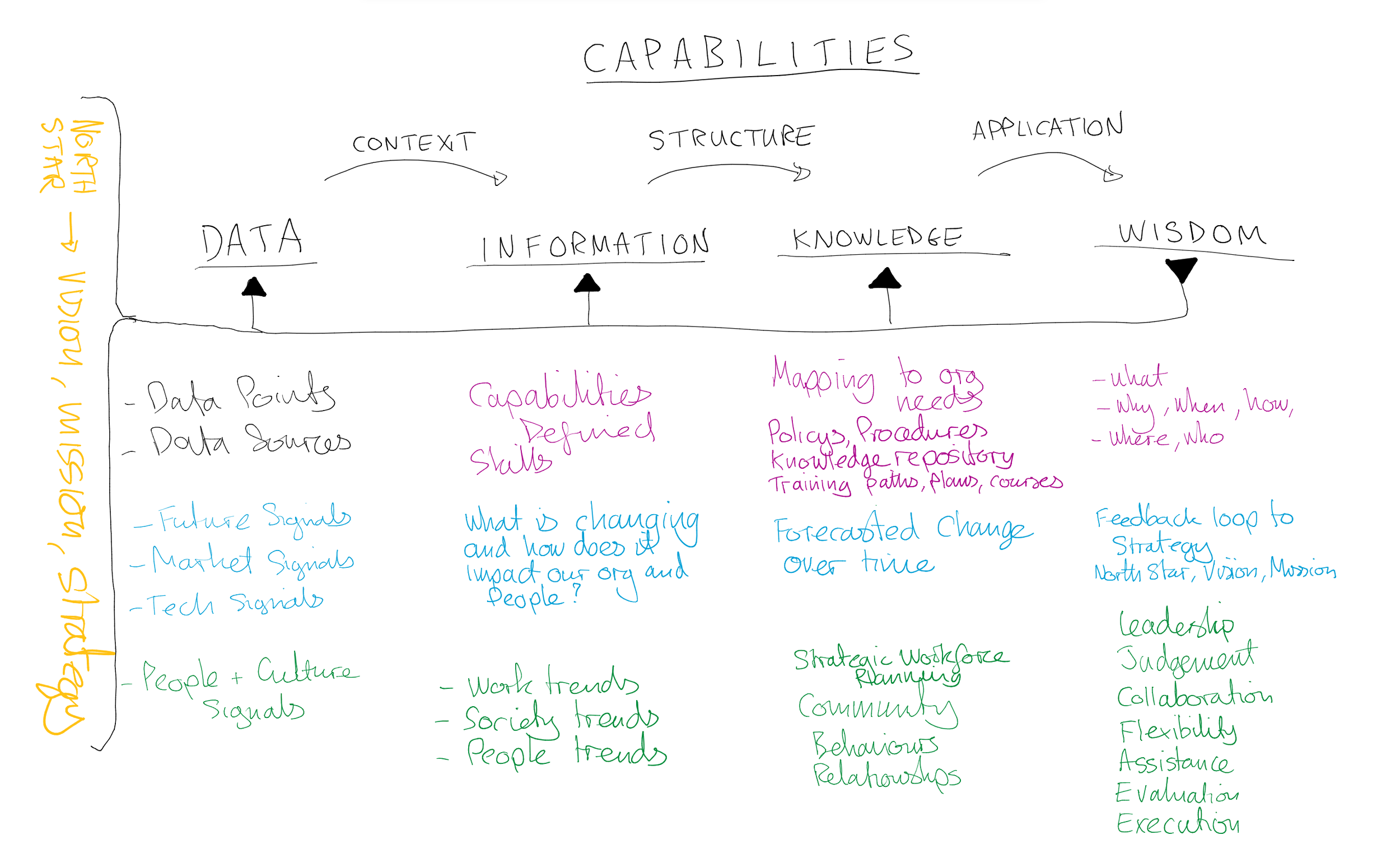
The Capabilities sketch: Data, Information, Knowledge and Wisdom linked by Context, Structure and Application, feeding back to the North Star.
Here’s where I think a concrete example earns its place, because I don’t think any of this lands without one. Take a phrase I hear constantly right now, on job specs, on org charts, in board packs. AI governance. An organisation decides it needs “AI governance capability,” writes that down as a single line, maybe hires someone against it or sends a team on a course, and moves on feeling like the box is ticked. It isn’t wrong to want that. It’s just miles too coarse to actually build against. The moment you pull that one phrase apart into what a person or a team genuinely has to be able to do, it stops being one thing and turns into close to a dozen separate abilities, most of which never made it onto the job advert. There’s the ability to give a proposed AI use a visible way in the door, so it doesn’t just get built quietly by someone with a laptop and good intentions. A separate ability to describe that use clearly enough that someone else can actually make a decision about it. Another to triage it, so the low-stakes ones go one way and the ones touching real people’s data or real decisions go another. A further ability to screen for the hard no’s, the things that get stopped regardless of who’s asking. Then assessing the risk properly across several dimensions at once, without quietly averaging away the one dimension that actually mattered. Then classifying that risk in a way you could defend to someone senior if they asked. Then making, recording and actually standing behind a gate decision. Then designing controls that are proportionate rather than reflexively maximal. Then keeping all of that current as the situation underneath it keeps changing. Then producing evidence, on demand, that any of this happened the way you’re claiming it did. And then, separately again, being ready to respond and learn properly when something goes wrong anyway, because eventually it will.
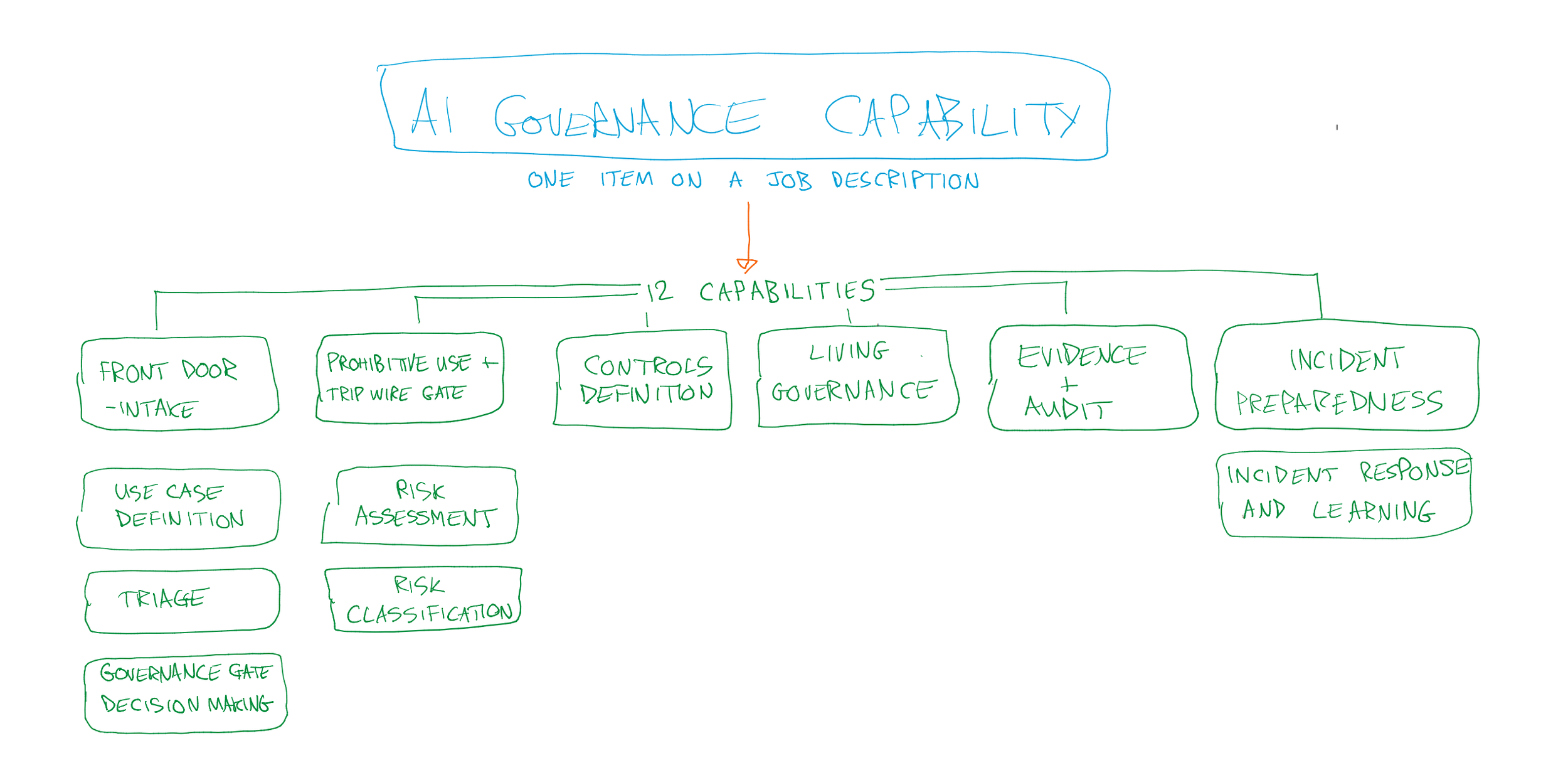
The AI Governance Capability tree: one line on a job description unpacked into 12 canonical capabilities across six modules.
That’s roughly a dozen distinct capabilities sitting underneath one tidy line on an org chart. Training can genuinely help with most of them. You can teach someone the risk dimensions worth checking, or the shape a use-case description needs to take, or the format a control record should follow. What training can’t manufacture on its own is the last handful. Actually making the gate decision, under real pressure, with a real person and a real deadline on the other end of it. Deciding a control is proportionate rather than either negligent or paranoid, when reasonable people in the room disagree. Recognising that a situation has drifted far enough from the version that was originally approved that it genuinely needs to go back through the gate, rather than being quietly waved through because everyone’s busy. Those aren’t knowledge gaps. They’re judgement calls wearing a governance process as a disguise. And I think that’s exactly the trap the “build it yourself” box in my first sketch was hiding. An organisation writes “AI governance” on a slide, builds a course for it, even builds a genuinely well-designed gate process around it, and quietly assumes the judgement part will just show up once the process exists. Sometimes it does. I don’t think we can keep assuming that.
Here’s the thought I can’t quite let go of, though. When most organisations say they’re “building capability,” I think they’re almost always building the middle two columns. Turning information into knowledge. Documenting it, structuring it, proceduralising it, exactly the way that AI governance example does for most of its dozen parts. And where they do reach into that last column, into wisdom, what they’re usually doing isn’t building it. They’re trying to capture it. Taking whatever judgement already exists in their most experienced people and converting it into a decision tree, a playbook, a set of rules good enough that someone with far less experience can follow them and get a defensible answer most of the time. That’s not a criticism. It’s often the right thing to do, because it means a much larger group of people can now handle situations that used to require someone rare and expensive.
But I think it only really works for a portion of what actually shows up. Call it eighty percent, roughly, of the situations an organisation encounters, where the pattern is familiar enough that a good procedure, a good gate, a good playbook gets you to a good outcome. The other twenty percent doesn’t behave like that at all. Going back to the example, it’s the use case that technically passes every check in the process but still feels wrong. It’s the classification two reasonable reviewers would score differently. It’s the moment somebody has to decide whether a small, incremental change to an already-approved system is small enough to wave through or serious enough to trigger the whole gate again. Nobody’s written a playbook for that particular version of the situation yet, because it hasn’t happened in quite that shape before, or because it sits across governance, technical risk and commercial pressure all at once, and the person who genuinely understands all three doesn’t exist on that org chart. That twenty percent still needs a person, or a small group of people, capable of genuine breadth and genuine depth at the same time, willing to depart from the playbook and take responsibility for what happens next.
And this is where the question that’s been bothering me all week finally surfaces properly. If we’ve spent years getting steadily better at converting the top of that stack into the middle of it, capturing judgement and turning it into procedure, have we been quietly running down our capacity for the twenty percent the entire time, simply because we’ve never needed to notice? Because until recently, the cost of that erosion was hidden. There were always enough people around who’d come up through the old, harder version of the work, and their judgement was still available even while the organisation was busy proceduralising everything beneath them. I wonder whether AI is less a new problem and more a very fast light being shone on an old one, because it’s now automating some of the very same eighty percent that used to be the training ground where those people quietly became capable of handling the twenty in the first place.
I don’t think that’s an argument against building any of this. I’m not about to suggest we deliberately leave things inefficient so people can learn the hard way, that would be a strange kind of self-sabotage. But I think it does mean the box in my first sketch, the one asking what capability I need, has to include an honest answer about where the next generation of twenty-percent judgement is actually going to come from, given that the eighty percent that used to grow it is disappearing under our feet. And I don’t yet have a clean answer to that. I have a strong suspicion that it starts with seeing capability far more clearly than most organisations currently can, not just what people know, but where judgement is concentrated, where it’s forming, and where it’s quietly draining away without anyone noticing until the twenty percent situation turns up and nobody’s ready for it.
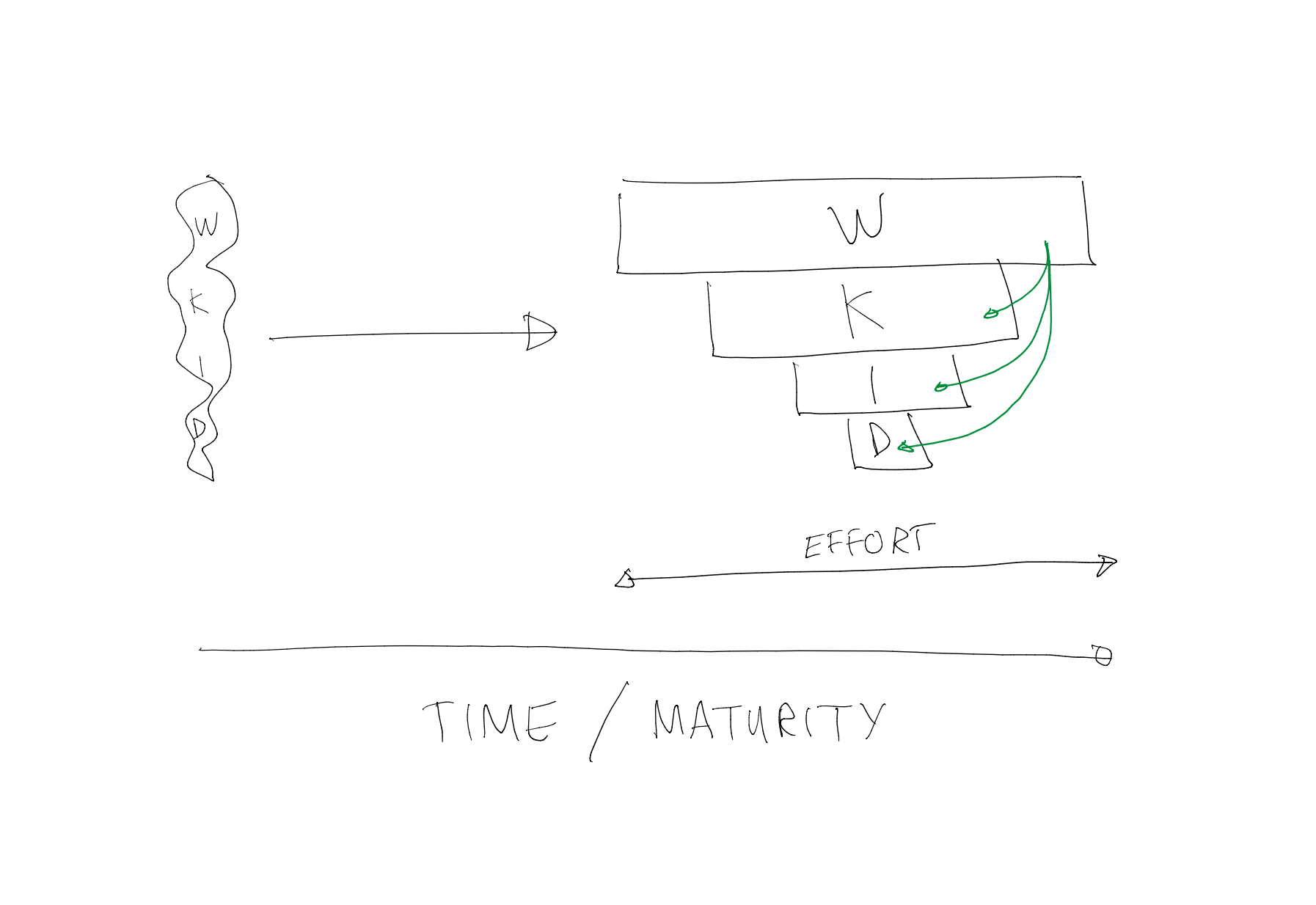
The frontier diagram: an undifferentiated squiggle resolving into an inverted Wisdom-Knowledge-Information-Data pyramid, with Effort and Time/Maturity axes and a feedback loop from Wisdom back down through the layers.
Exploring Human Capability in an AI World
Part 1: What If Knowledge Was Free?
Part 2: Maybe Wisdom Isn’t One Thing.
Part 3: The Capability Factory.
Part 4: The Hidden Curriculum.
Part 5: Capability Compounds Through Exposure.
Part 6: Why People Follow.
Part 7: Where Does Judgement Come From?
Part 8: Everything Leads Back to Judgement.
Part 9: Where Will Tomorrow’s Wisdom Come From?
Coming Next: If most organisations are quietly running down the very conditions that used to produce judgement, what would it actually take to build them back deliberately?
