
Impact of AI 10 - Building Judgement Through a Frontier Capability Organisation
I ended the last piece with a question I didn’t have an answer to. If organisations keep getting better at turning yesterday’s judgement into today’s procedure, and AI is speeding that up rather than slowing it down, where does tomorrow’s judgement actually come from. I said I had a suspicion it started with seeing capability more clearly than most organisations currently do. I didn’t say what came after seeing it. That’s what this piece is for.
Before I get to that, I want to go back to the picture I ended on, because I don’t think I pushed it far enough the first time. Every organisation, for every capability it cares about, sits somewhere on the same journey. Start with something genuinely unstructured, uncertain, nobody’s quite sure what’s going on yet, everything tangled together because nothing’s been separated into data, information, knowledge and wisdom because nothing’s been separated at all. Over time, structure appears. Data gets captured. Patterns become information. Information gets organised into knowledge. And for a while, wisdom sits right at the top of a very lopsided pyramid, doing almost all the work, because nothing else exists yet to share the load.
Here’s the part I only half-said last time. That pyramid doesn’t stay lopsided forever, and what happens to it next is a genuine fork, not an inevitability. One path keeps codifying, the way it should, but never stops feeding something back into the layers underneath. Wisdom gets applied, the application creates new signals, the signals renew the knowledge and the data beneath them, and the loop keeps running for as long as anyone keeps investing in it. The other path codifies too, exactly as effectively, but the loop quietly stops. Nobody decides to stop it. It just isn’t kept running, because keeping it running costs more effort than letting it lapse, and there’s rarely a moment where the cost of stopping is obvious until it’s too late.
Both paths look identical from the outside for quite a while. Both produce good procedures, good playbooks, good short-term numbers. The difference only shows up later, and it shows up exactly where I said it would in the last piece. In the twenty percent. The situation nobody’s written a rule for yet. On one path, there’s still someone capable of handling it, because the organisation kept investing in the conditions that produce that kind of person. On the other path, the procedures are all still there, beautifully documented, and there’s nobody left who can tell you what to do when the procedure doesn’t fit.
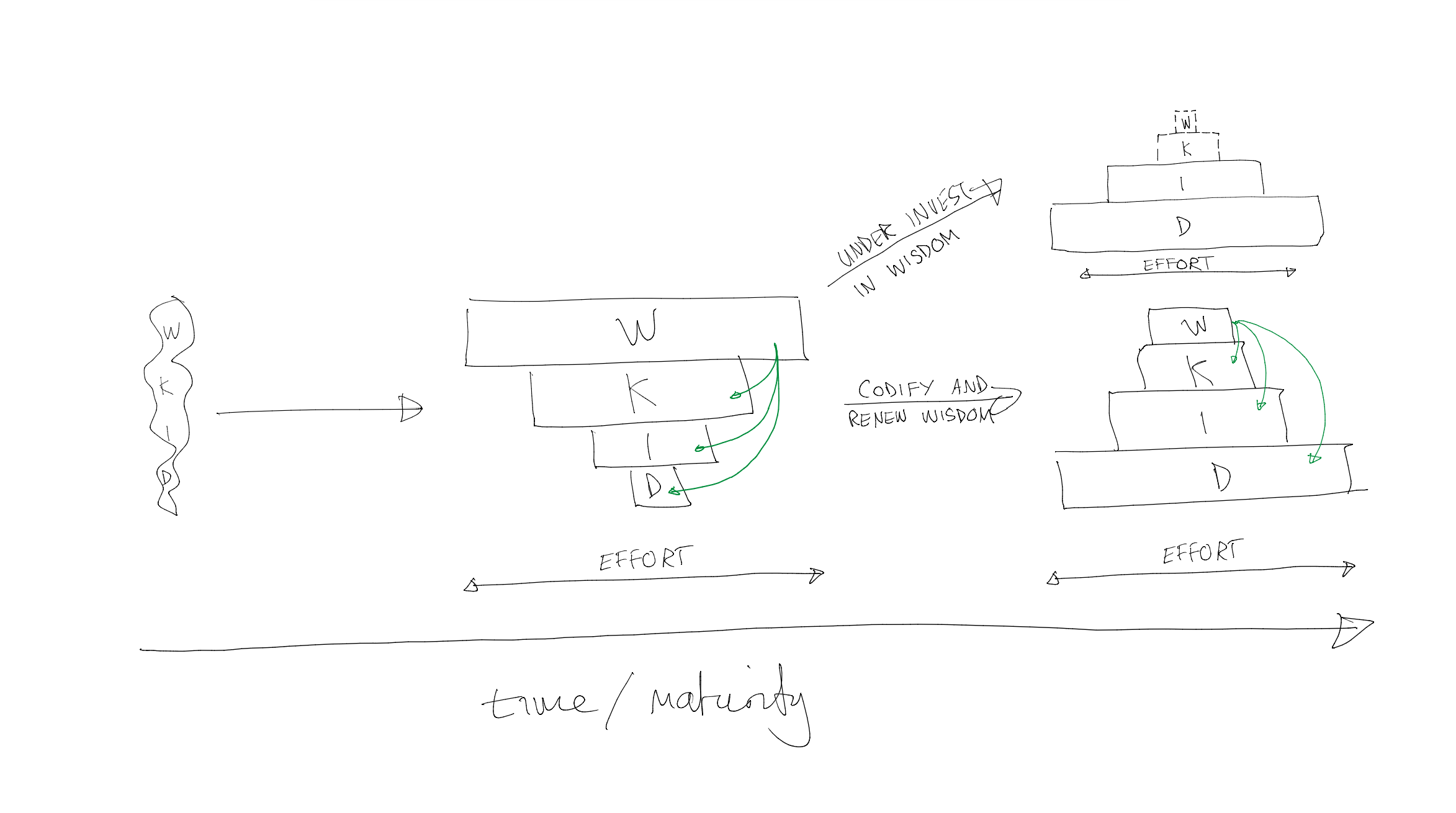
The fork: an undifferentiated squiggle resolving into a lopsided pyramid, then splitting over time into two futures, one that quietly stops renewing wisdom and one that keeps investing to renew it.
So here’s the actual question I think Blog 9 was building toward, even though I didn’t phrase it this way at the time. It isn’t “how do we stop this from happening.” Every organisation is on one of these two paths whether it decides to be or not, simply by choosing where to invest and where not to. The real question is what you’d actually have to build, on purpose, if you wanted to be on the first path rather than drifting onto the second one without noticing.
The Frontier Capability Organisation - FCO
I’ve been calling the answer a Frontier Capability Organisation, mostly because I needed a name for it and that’s the one that stuck. Not because AI is at the frontier. Because judgement is. The frontier isn’t a place technology lives. It’s the edge where the map runs out and someone still has to decide what to do, and I think that edge is exactly where the twenty percent from the last piece actually sits.
There’s a story I keep coming back to that makes this concrete rather than theoretical. Home Depot, the large American home-improvement and hardware retailer, has spent decades deliberately recruiting from the trades, plumbers, electricians, builders, plasterers, painters, so that a customer walking in with a problem gets an actual tradesperson in an orange apron, not someone reading from a script. There’s a story about a customer who came in expecting to pay a couple of hundred dollars for a new kitchen tap / faucet. The plumbing expert they spoke to sold them a twenty-five cent washer instead, and showed them how to fit it. That customer told everyone they knew, and when they eventually renovated their kitchen, they spent a hundred thousand dollars with Home Depot.
That twenty-five cent washer is judgement, not knowledge, doing the work. A manual can tell you which parts fit which tap / faucet. It takes years of actually standing in front of leaking faucets to look at this one and know it’s a twenty-five cent fix rather than a replacement, and to make the call that selling someone less today is what builds the kind of trust that shows up again later. Home Depot didn’t get that by writing a better manual. They got it by recruiting people who already had the judgement, built through years of real trade experience elsewhere, and then building a store around letting that judgement get used, and passed on, every single day.
Decades later, Home Depot launched something called Magic Apron, a generative AI tool built explicitly to digitise that expertise, trained on product manuals, installation guides, how-to videos and safety documentation. Their own language calls it bringing “that same expertise to the digital world.” I think that’s honest marketing, but it’s only describing one layer of it. Magic Apron can tell a customer which washer fits their tap / faucet. It cannot tell them that fixing it for twenty-five cents, rather than replacing it for two hundred dollars, is the decision that eventually earns a hundred-thousand-dollar kitchen renovation. That call was never written down anywhere. It lived entirely in one plumber’s years of experience, and it still does.
That’s the whole argument of this piece in one company, across one timeline. Get the judgement layer right first, deliberately, and the knowledge layer built on top of it afterwards is additive. Try to build the knowledge layer without ever having invested in the judgement underneath it, and you end up with something that sounds like expertise but can’t actually make the call that matters. A Frontier Capability Organisation is what it takes to be Home Depot’s first move, on purpose, rather than getting lucky with who you happened to hire decades ago.
I don’t think it’s a structure you install. I think it’s closer to a set of habits an organisation has to keep practising, the same way a garden doesn’t install a good harvest, it tends the conditions that make one possible. Four of those habits keep showing up whenever I try to draw this out properly.
Sensing and Direction
The first is knowing where you’re actually trying to go, before you ask what capability you need. I keep drawing the same shape for this. Demand pulls from one side. Vision, mission and strategy pull from the other. Both of them converge on something I’ve taken to calling the North Star, not because it’s mystical, but because it’s the thing that answers three questions an organisation has to keep asking itself honestly: what’s actually happening, where are we trying to get to, and what do we need in order to get there. Skip this step, and the capability question becomes unanswerable, because you end up building a list of skills with no idea what they’re actually supposed to be in service of.
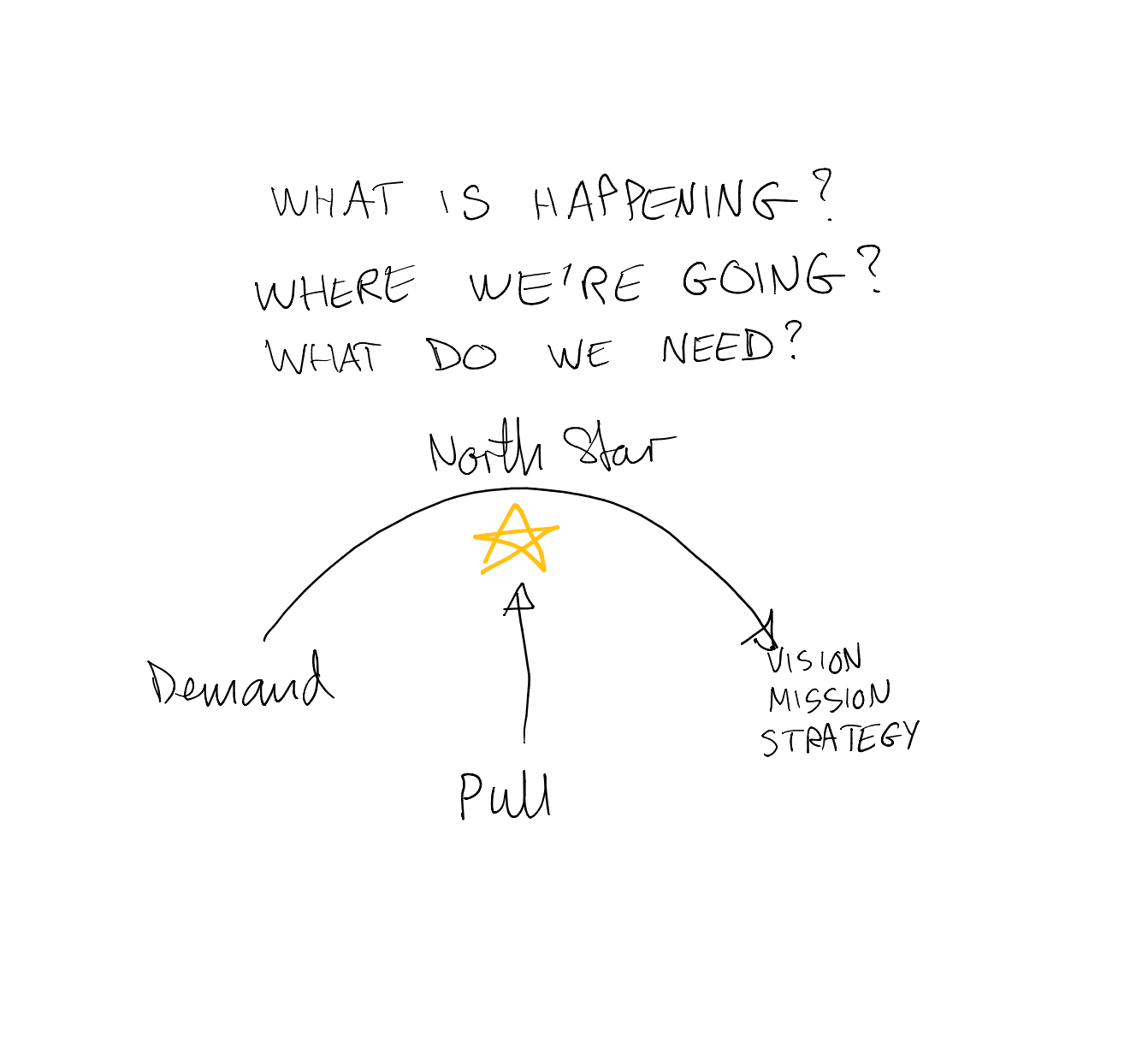
Sensing and direction: Demand and Vision/Mission/Strategy both pulling toward a North Star, answering what's happening, where we're going, and what we need.
There’s something in that word Pull I want to be honest about, because it would be easy to read the diagram as just a fancier way of saying “get everyone aligned to the strategy,” and that’s not really what I mean by it. Pull, the way I’ve drawn it, isn’t the organisation deciding on three priorities and pushing them out through a town hall and an intranet post. Genuine pull is emotional before it’s anything else. It’s whether someone actually wants to be part of what’s happening, which is a much harder thing to manufacture than a well-worded strategy slide, and most organisations never really try, they just assume alignment will follow from clarity.
I’ve used this example before in this series, so I’ll try not to lean on it too hard again, but I don’t have a better one. At GSK, eight of us started meeting for an hour a week, mostly just curious, mostly just wanting to get better at things nobody was formally teaching us. By the time I moved on, that had grown into something people were calling the Power Rangers, more than four and a half thousand people, across over seventy countries. Nobody was told to join. It wasn’t in anyone’s objectives. What made it spread wasn’t a mandate, it was that it put the individual at the centre rather than the organisation, and it answered a question most transformation programmes never bother asking properly, which is what’s actually in it for the person being asked to change. The organisation had its own North Star it was trying to reach, largely unrelated to any of this on paper. What the movement actually did was let people build capability that mattered to them personally, in a way that happened to pull the organisation toward where it needed to go anyway.
That’s the bit I think most organisations miss when they draw this picture. They sketch the arc, they name the North Star, and they assume pull will simply show up because the strategy is correct. It won’t. Pull has to be designed for, the same way capability does. It has to answer what’s-in-it-for-me honestly, not paper over it with a mission statement, or it isn’t pull at all. It’s just push wearing a nicer font.
Capability Visibility
The second habit is being honest about what you’ve actually got, rather than what you assume you’ve got. This is where I think most organisations quietly fool themselves, because they mistake a skills matrix for capability visibility. What you actually need is something closer to an observatory. Not a dashboard that tells you who completed which course, but a genuine, ongoing sense of where capability is concentrated, where it’s forming, where it’s thinning out, and whether the investment going into it is enough to keep the whole thing renewing itself. I keep drawing this as an eye, sitting at the centre of a loop, because that’s honestly what it feels like when it’s working. Not a report you read once a quarter. Something that’s actually watching, continuously, and feeding what it sees back into the next decision.
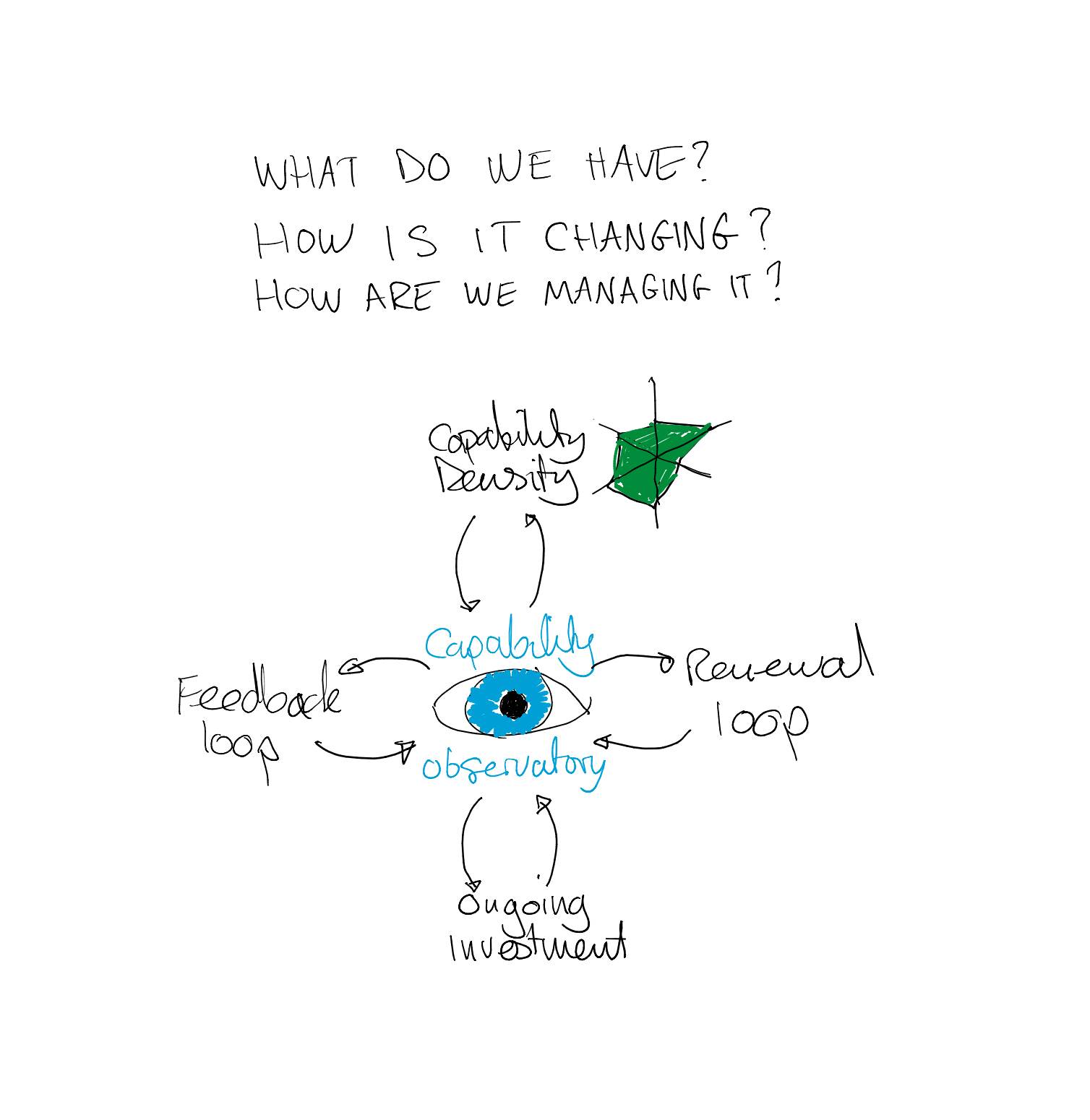
Capability visibility: the Capability Observatory sitting at the centre of a continuous loop between Capability Density, feedback, renewal and ongoing investment.
Building and Deciding
The third habit is deciding, deliberately, who actually gets to make the call when the map runs out, and then making sure somebody’s actually capable of making it. This is the part the AI governance example from the last piece was really about, underneath all the module names. It isn’t only a question of decision rights, though those matter, somebody genuinely does need to own the gate decision, the control judgement, the moment where a small change either gets waved through or sent back for a proper look. It’s also a question of exposure. You don’t get people capable of making that call by accident. You get them by deliberately putting people in front of situations that stretch them, with real consequences attached, before the day arrives when the stakes are actually high. Human-agent mobilisation sits right in the middle of this one too, because increasingly the honest answer isn’t “a person handles it” or “an agent handles it,” it’s a person and an agent working the problem together, with the agent doing more of the heavy lifting at the routine end and the person doing more of the deciding at the frontier end.
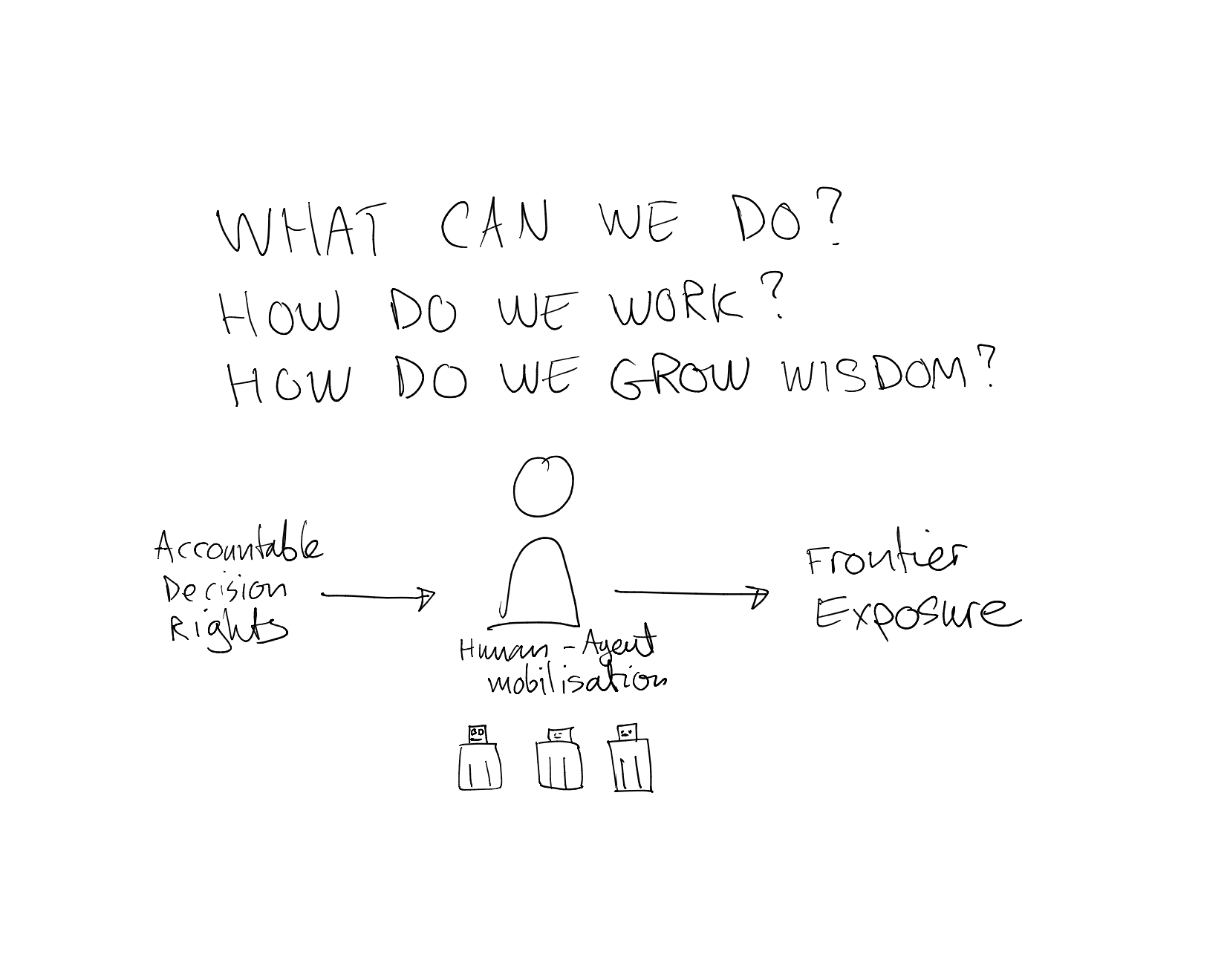
Building and deciding: Accountable Decision Rights feeding into Human-Agent Mobilisation, which in turn builds Frontier Exposure.
Connecting
The fourth habit is accepting, properly accepting, that no organisation is going to hold every capability it will ever need, on its own, indefinitely. This is the one I think gets skipped most often, because it feels like an admission of weakness rather than what it actually is, which is just realism. People connect across organisational lines. Organisations connect with other organisations. Capabilities connect with other capabilities that complement them. None of that is outsourcing in the sense of handing the problem away. It’s closer to what happens in any healthy ecosystem, different specialisms, different strengths, all connected well enough that the whole thing can do more than any single part of it could alone.
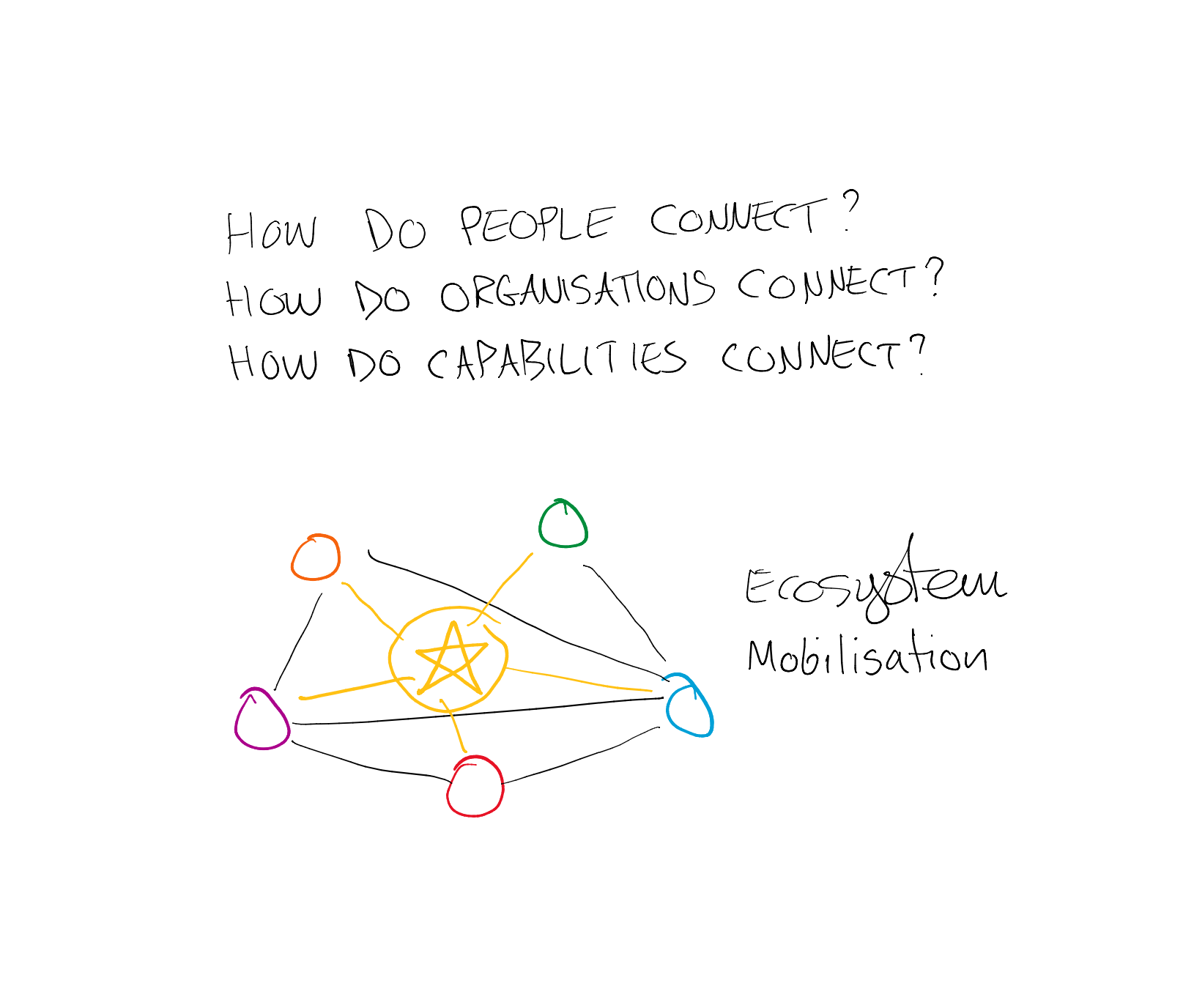
Connecting: five differently-coloured nodes connected to each other and to a shared centre, representing Ecosystem Mobilisation.
None of these four habits sit on nothing. Underneath all of them are two things that aren’t really a fifth habit alongside the others, they’re the ground the other four are built on. Trust as infrastructure, not bolted on afterwards as a policy nobody reads, but built into how decisions get made, challenged and corrected from the start. And an underlying data platform that actually connects capability to context, evidence and outcome, without tipping over into watching people rather than helping them. Without a genuine data platform, the Observatory has nothing real to watch. Without trust built into the structure itself, nothing built on top of it holds any weight at all.
Here’s the thing that’s only really clicked for me while writing all of this down. None of these four habits are asking an organisation to buy something, or install something, or hire a rare expert who happens to already have the judgement everyone’s missing. They’re asking an organisation to build the conditions under which its own people, and its own agents, and the wider network it sits inside, keep producing new judgement, faster than the old judgement gets used up. Which brings me right back to where this series actually started. I called the first piece in this series What If Knowledge Was Free? I think that question has an answer now, and it isn’t the one I expected when I wrote it. Knowledge being free was never really the point. It just cleared the ground so the real question could surface. If knowledge is free, and increasingly it is, then what an organisation actually has to build, deliberately, is the thing that turns free knowledge into wisdom nobody can simply download.
Building the Frontier Capability Organisation
I’ve spent the last several months building something in response to that question, mostly because I couldn’t find anyone else’s answer that satisfied me. I’ve been calling it EmPOWER Your World, EYW for short, and until now it’s mostly existed as this blog, a set of ideas I’ve been testing in public one piece at a time. I think it’s time I said a bit more about what’s actually been built underneath it, not because it’s finished, but because I think the amount of thinking behind it is itself evidence for the argument I’ve just made.
Over the last four months, that’s taken shape as an actual architecture rather than a set of blog-post ideas. There’s a North Star that the whole thing points toward, and beneath that, a series of Transformation Motions, broad routes an organisation can take depending on what it’s actually trying to do, getting started safely, scaling responsibly, redesigning work around AI, several others besides. Underneath those sit Journeys, practical routes through a specific problem, and underneath those, a growing library of Modules, thirty-four of them built so far, each one a reusable building block rather than a one-off deliverable. And running through all of it, a set of different ways to actually engage with the material, some of it entirely free and public, some of it opening up further through workshops, membership, practitioner accreditation, all the way through to full organisational partnership, so nobody has to buy anything to start, and there’s a real path for anyone who wants to go deeper.
I’m not laying that out to sell you anything. I’m laying it out because I think it matters that this wasn’t built after the fact to justify a blog series. The architecture and the argument arrived at the same place independently, one built in public, one built in private, and I think that’s a more honest thing to say than pretending I had it all figured out from the start.
Piece One
The first piece of that is going out at the same time as this post. It’s called J01, Make AI Adoption Safe, and it’s the first Journey built on this thinking, free, public, and yours to download whether or not you ever hear from me again. It won’t tell you everything. It’s deliberately the accessible layer, not the full instrument set. But it’s real, it’s usable now, and I’d rather you judge the thinking by something you can actually pick up than by anything I could tell you about it here. And it’s genuinely just the first one. There are more Journeys already taking shape behind it.
Piece Two
The second piece is that I’m taking this out into rooms with real people who’ll tell me where it doesn’t hold up. I’ll be talking about the gap between experimenting with AI and actually adopting it safely at CollabDays Bletchley Park. I’ll be using the Norfolk PP User Group to properly stress-test this thinking with people who have no reason to be polite about it. And at the South Coast User Group, there’s a full workshop built around actually working through J01 together, not just hearing about it.
CollabDays Bletchley Park - Wednesday 23rd September 2026 - CollabDays Bletchley Park 2026 | Collabdays
Norfolk Power Platform User Group - Thursday 15th October 2026 - https://www.meetup.com/norfolk-power-platform-user-group/events/316514037/
Microsoft Cloud South Coast User Group - Workshop Thursday 22nd & Session Friday 23rd October 2026 - https://www.eventbrite.com/cc/south-coast-user-group-two-day-flagship-event-4832487/
Piece Three
The third piece is the smallest and probably the most important. There’s a Slack channel now, #make-ai-adoption-safe, open to anyone, no tier, no gate. If any of this resonates, or if you think I’ve got it wrong, that’s where I’d genuinely like to hear it.
Empower Your World - Capability Ecosystem - Slack Channel - https://join.slack.com/t/empoweryourworld/shared_invite/zt-49rkabu5t-rmQPUiCKGeZhTOCYMiTGHg
Come and join the capability ecosystem experiment
And that’s really the point I want to end on, because none of this works as something I build alone, in a room, and hand to everyone else finished. I’d love for you to come along on this with me. Test the thinking. Pull the Frontier Capability Organisation model apart and tell me where it doesn’t hold. Download J01 and the materials that follow it, use them for real, and tell me honestly what breaks when they meet an actual organisation rather than a blog post. Join the Slack channel, not as a spectator, but as someone willing to challenge, improve, and argue with what’s there, because that’s genuinely how I think this gets better.
I don’t think this is a problem any one type of person solves alone, which is exactly why I’d like as wide a range of people as possible in the room. If you’re just starting out, or switching into this field from somewhere else entirely, your questions are often the ones that expose what the rest of us have quietly stopped noticing. If you’re further along, a Fractional CAIO, a CISO, a transformation lead, someone living in governance, risk or compliance, a practitioner actually doing the work day to day, you’ll recognise pieces of this from the inside, and I’d rather hear where it’s wrong than have it sit unchallenged. And I don’t think this is only a technology or delivery conversation. It needs people who understand organisational change and transformation properly, and it needs behavioural psychologists, because so much of what I’ve described here, pull rather than push, exposure that actually builds judgement, trust as infrastructure rather than policy, is fundamentally about how people behave, not just how systems are designed.
If any part of this has resonated, whichever seat you’re reading it from, I’d genuinely love to have you as part of building it properly, together, out in the open, rather than me guessing at the rest of it on my own.
Exploring Human Capability in an AI World
Part 1: What If Knowledge Was Free?
Part 2: Maybe Wisdom Isn’t One Thing.
Part 3: The Capability Factory.
Part 4: The Hidden Curriculum.
Part 5: Capability Compounds Through Exposure.
Part 6: Why People Follow.
Part 7: Where Does Judgement Come From?
Part 8: Everything Leads Back to Judgement.
Part 9: Where Will Tomorrow’s Wisdom Come From?
Part 10: Building Judgement Through a Frontier Capability Organisation
