
Cowork = My Collaborative Worker
The last few weeks I’ve been experimenting with Microsoft Cowork and I’ve decided it’s now my superpower… As long as I don’t burn out! I believe that when Cowork becomes Generally Available (rather than part of the Frontier preview as it is currently) this is going to be a HUGE productivity disruptor!
Here's how I turned Cowork into a coworker that builds my whole content library to a standard and what I learned about not burning out
Cowork is a flavour of Microsoft’s Copilot - Rather than a simple back and forth conversation, or a targeted agent, this Agent is a Coworker who you can delegate larger, more complicated, multi-step challenges to. This Coworker can use skills, and tools, to reason over complex pieces of work, partner with you to make decisions, choose directions, and create high quality outputs. Your brain and experience leads the way, Cowork takes away the heavy lifting for you without trying to replace you!
I see Cowork capabilities sitting on a spectrum between M365 Copilot to Foundry: For me Cowork sits between using Agent Builder in ‘M365 Copilot’ to build focused agents to help with a specific task, and Copilot Studio where larger complexity, more tightly controlled AI solutions are built and governed. This is a capability that could be for anyone across an organisation and as a result will be a GAME CHANGER! But as we learned from Spiderman - “With great power comes great responsibility” and we’ll have to think about how we use it for good. More about that further down!
I used Cowork to enable a number of different outcomes:
To better define the problem
To design the structure of the approach and set standards
To collaboratively create content
To perform quality control of content
To create an operating model to learn, to use, to generate outputs and enable business value.
The challenge I set myself
I’ve been experimenting with it to experiment, learn, test, with the goal of extending my scalable governance model approach to Power Platform governance and enablement, to the world of AI governance and enablement.
The scalable governance model gave us a way to model multi-dimensional risks associated with use cases - Data risks, operational risks, financial risks, supportability risks. Translating these to a ‘risk size’ and providing a guided path to right size the governance and design how we use platform, processes, and people, to do the right thing.
AI Solution risks have those same considerations but more layers and types of risks too. I set out to start solving this ‘wicked problem’ and come up with an enhanced model to translate all this complexity into a model that can be implemented in any organisation to implement, scale, and maximise value whilst managing risk.
How I approached the problem using Cowork
1) Provided my thoughts and ideas and asked questions to shape the challenge I was trying to solve
I already had been investigating and pondering this problem, researching some of the legal challenges that AI brings (e.g. through the EU AI Act), the different ways AI solutions can be categorised. I augmented that with Cowork to explore the wider challenges - For example - What it can do, the size of the blast radius if something went wrong, what data it’s using, and how governable it is - what can be audited and tracked, who runs it.
2) Structure the challenge with Cowork
The first real job I handed Cowork was to turn a messy 'wicked problem' into a structure that any agent, or person, could pick up and run with. I gave it my half-formed thinking - the layers, the modules, the kinds of assets I had in mind - and it worked with me to shape it into something logical and consistent.
What mattered here wasn't the taxonomy itself (I'll dig into that structure properly in a post of its own soon). It was watching Cowork act as a genuine thought partner… questioning my groupings, spotting the gaps, and holding everything to one standard so the pieces actually fitted together.
What we landed on was a layered model - foundations at the bottom, through to change and adoption at the top - with a consistent bundle of assets sitting behind each module.
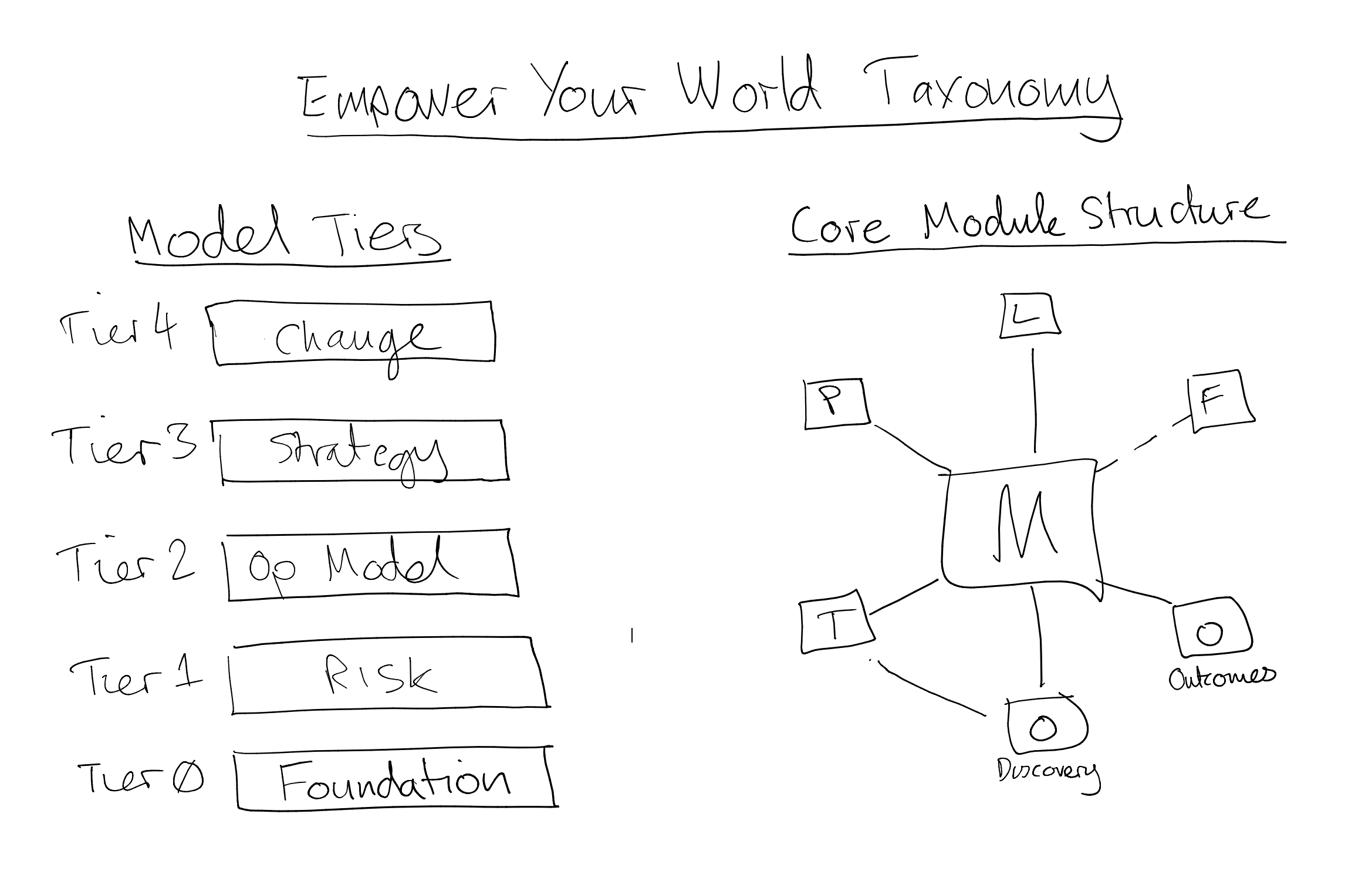
Empower Your World taxonomy
But the headline for this post isn't the model. It's that Cowork helped me design it, then built to it - to the same standard, every time. More on the full taxonomy, the tiers, and the asset set in that dedicated post.
3) Creation process
I started experimenting and creating module content, refining it, and iterate on it - piece by piece understanding what the standards and rules and processes are that I want to have in place. This diagram shows my final (or at least current) E2E process from kicking off a new module family, or doing a review and update of an existing one to introduce new content or ensure alignment with new standards I implement.
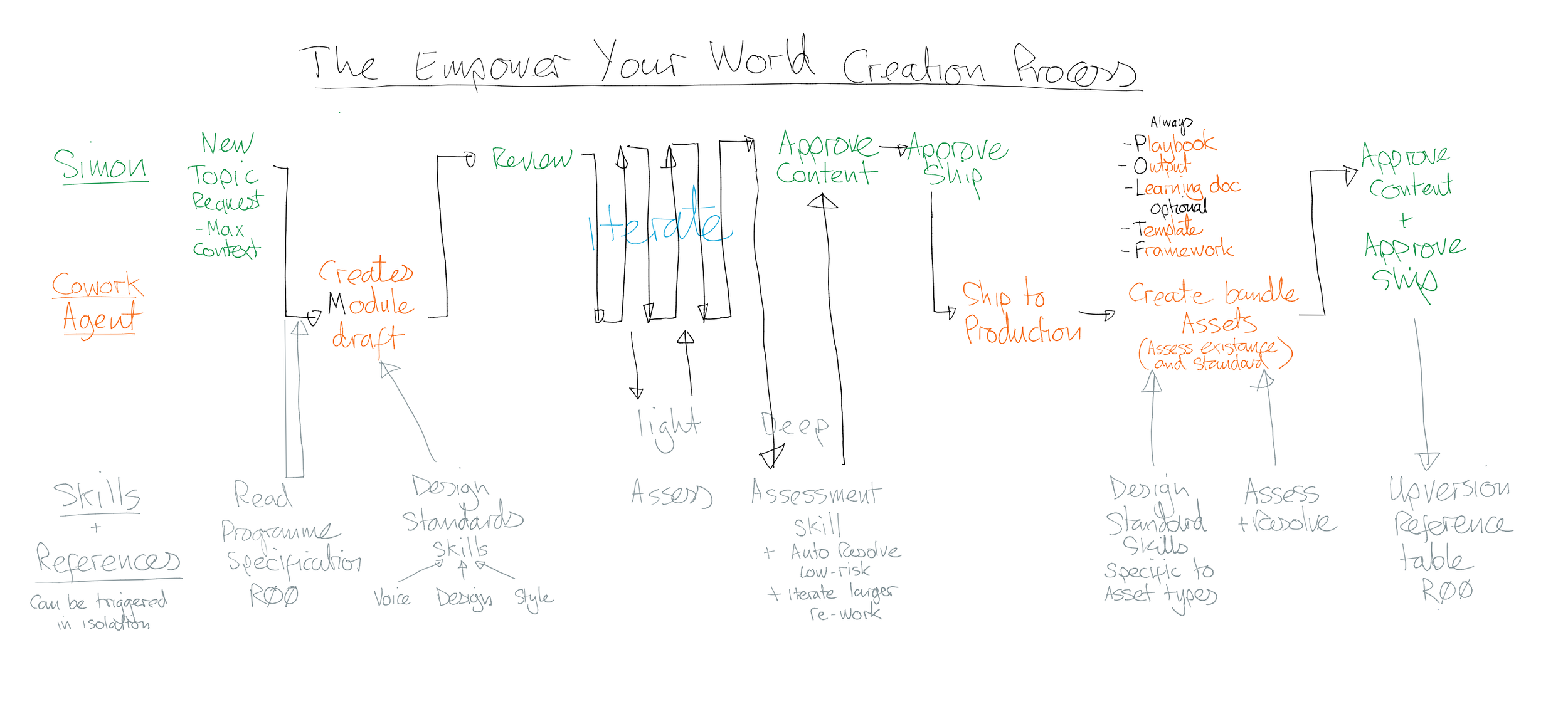
Process flow of the end to end process I’ve developed to aid me in thinking, creating, checking, and evolving.
I’m certainly seeing Cowork as a true ‘Coworker’ - From this process flow you can hopefully see that it’s been:
a thought partner to take my initial semi-structured ideas and with my guidance ask me questions to help me explore and refine those ideas to better understand my goals and requirements.
an asset creator that follows the rules and standards I’ve set up and the expectations I’ve set and then worked with me to iterate on it’s initial content to get it to what I want it to be.
a quality check and assesses against 8 different dimensions I’ve defined to ensure that my content is accessible, that it’s high quality, that it’s interconnected with the rest of my content, that it’s focused and not a gazillion slides long. (I still have a part to play in that, of course, but it’s a great check and signpost for where I could look and what I could consider.)
an admin who moves files, updates records and versions, records audit assessments and creates heat maps for me to see whats going on and make decisions on where I focus next, and keeps everything aligned.
an assistant who creates other supporting documents around the core content to aid in learning, delivery, decision making, and documentation creation.
Work, and how I perform it, is changing! Through these experiments my brain wiring is changing and recognising more opportunities!
This process consists of a number of components:
R00 EYW - Programme Structure - A Markdown document that defines the taxonomy and structure of the assets, the bundle of Assets that should be created once I’m happy with the content and structure of the Core Module, the design and accessibility styling and format of the different type of asset documents, my ‘voice’ and the language it should use, the principles and legal and security frameworks I should be aligning to - All activities refer to this as the canonical source of truth that ensures consistency across everything I create, either manually or using Cowork.
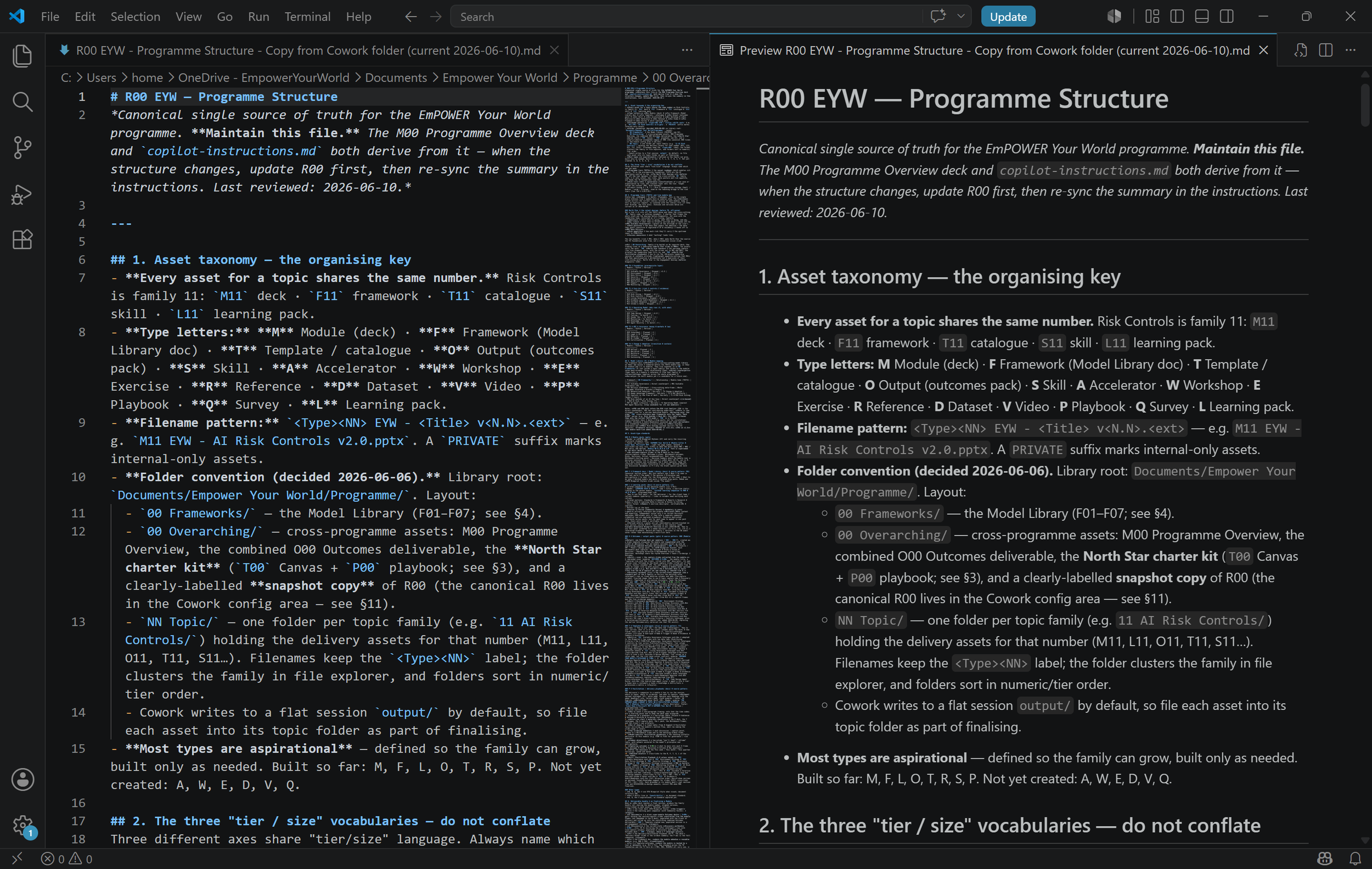
Screenshot from Visual Studio of my R00 Programme Structure Markdown file
Cowork Instructions - A Markdown file that sits in the root folder of Cowork that tells it to always read the latest version of my Programme Structure first to ensure it knows what the structure and rules are. It also tells it the technical lessons that it’s learned along the way e.g. what method it should use to encode PowerPoint outputs, which skills it should call for what sort of tasks, where the asset library is in my OneDrive so (on my approval) it can promote full versions to there out of the working session folder that it uses for each individual chat.
Various Skills - Skills are a markdown document for a specific task - You can think of them a bit like a Standard Operating Procedure (SOP) - they describe the outcome it’s trying to achieve, the rules of what it should or shouldn’t do and an what’s important or not important, the process steps it should go through to perform that task, guardrails to ensure it performs as you want, and when the skill SHOULDN’T be used. - I have skills for building a full module pack of assets, performing a quality and accessibility audit on assets, restructuring content into a standardised structure, doing an assessment of all my blog posts and identifying where there are Frameworks (F) that are described by combining multiple posts etc. - They’re a game changer!
What I’ve learned - benefits and anti-patterns
The opportunity
Wow! I’ve been blown away with how quickly how I work on problems has changed - I can see this is a massive accelerator… for those who understand their subject matter, and understand what outcome they’re trying to deliver, and what some of the pitfalls are, and not just consider the output but also the humans and processes associated with them and how it needs to integrate within a wider ecosystem or organisation. There’s a risk of just generating slop if you don’t understand enough about the topic… but… if approaching it as a learning tool and teacher as well as a work partner this can be mitigated - ask questions, ask for explanation, ask to help you understand, don’t just jump into creation and go with whatever it suggests and you’re more likely to get decent outputs.
The technology
This is good… REALLY good for something that’s only been out in public preview for a couple of months - Using it for tasks and then going back to using M365 Copilot to try to do something similar is sooooooo painful. My bar of expectations has risen so quickly using this tool!
It’s not perfect… The conversation hangs sometimes and I have to ask for a status report to wake it up… or to come out of that session or out of Cowork and go back in, or to go into the web client instead of the desktop client. If you’re working in the same session for a long time on a topic it can get locked up - I’ve had one session that was unrecoverable as it got into some kind of circular loop.
It can be a bit variable in it’s actions… Sometimes it happily let me add a tool to promote my session output docs into production in my OneDrive but other times it said it couldn’t… Sometimes it had problems reading the most recent versions of a reference file and so worked on what it remembered from a previous session or what it thought was probably the answer until I prodded it to check.
But… It’s in preview - this stuff is to be expected.
The people
I think there’s some risk here… I’m going to explore it more in a separate post as I’m conscious how long this one has become… but with the ability to work faster, do work in parallel, hand off the less brain intensive tasks and get the output almost immediately, I found myself doing more and more and more and my brain being ‘always on’ and constantly jumping between workstreams. THIS. IS. EXHAUSTING! There’s a real risk of increasing chance of burnout and organisations expecting more and more and more output, and comparing people based on quantity of output instead of quality and impact of output… I need to think about this more and write more about it but I drew a quick picture to get my initial thoughts on ‘paper’
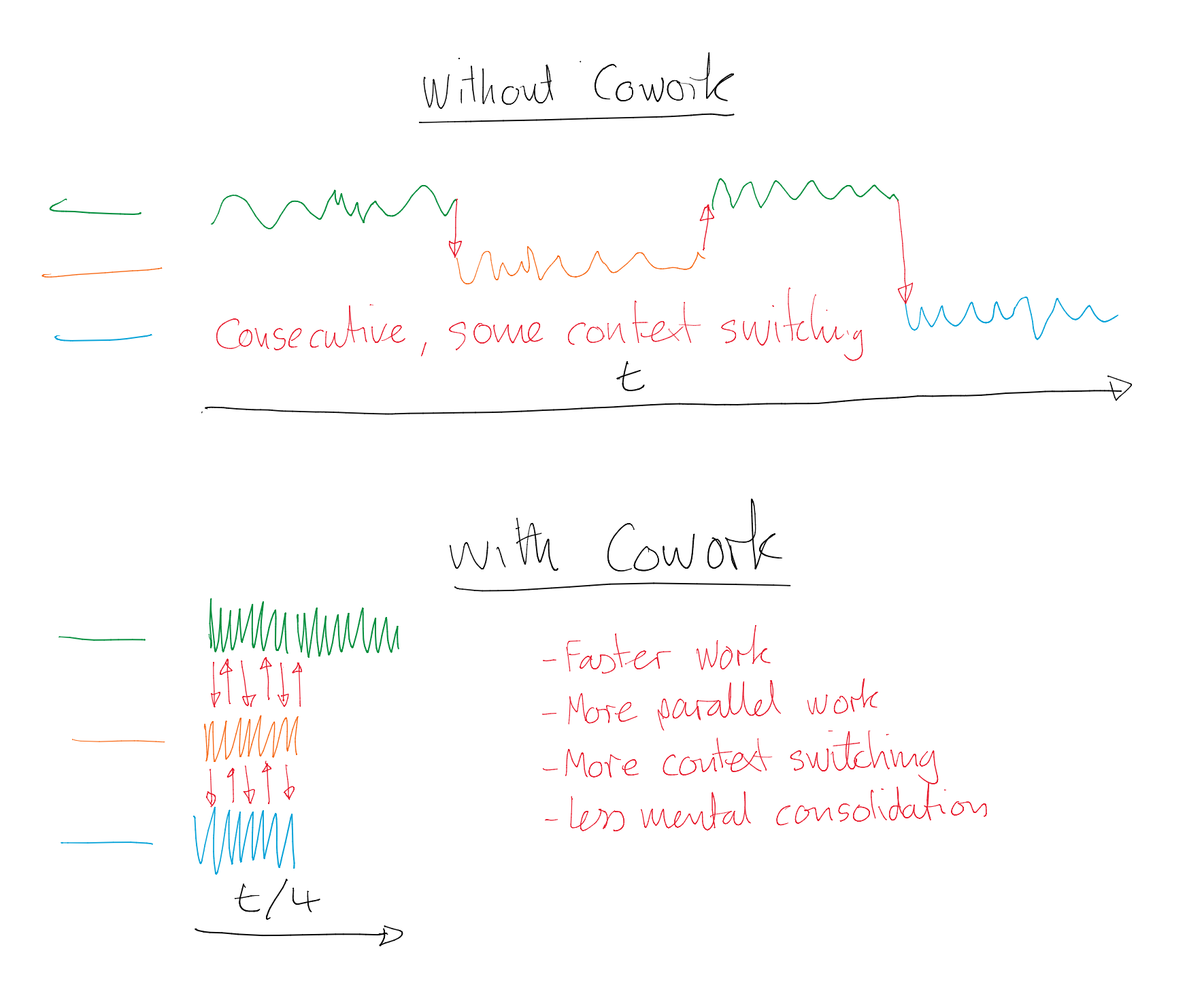
Comparison of work patterns with and without Cowork
What should you do next?
Turn it on! Pick one multi-step task you'd normally dread, give Cowork the context and the standard you want, and review its plan before it runs.
What does it mean to me?
Enterprise Architect: treat Cowork as a governed actor. Decide its blast radius, data scope, and audit trail before you delegate (your Scalable Governance model is the lens).
Transformation/Change Leader: the win isn't speed, it's capacity. Protect the human judgement and consolidation time Cowork frees up, or you trade burnout for a different burnout.
Microsoft Partner/Consultant: the repeatable asset is a governed delegation pattern (R00 + instructions + skills), not the output itself - that's what you productise for clients.
If you’d like to see a more formalised overview of what I’m doing with my Empower Your World activities and experiments, how I’ve structured the modules, you can read an overview that Cowork helped me generate including versions of some of these diagrams that it created when I gave it screenshots of my drawings and describing what I wanted.
I’d love to hear about your learnings from your Cowork experiments or your ideas on how this could change Your World or that of your organisation - Come and join the conversation on LinkedIn or reach out directly to me -
