
Model 08 · AI ROI
Most AI business cases are written at the moment of maximum optimism.
Value is treated as if it is already real. Cost is treated as if it is mainly a one-off decision. The launch deck looks confident, the pilot looks promising, and the organisation moves forward as if the return has already been earned.
AI does not behave like that.
The more a useful AI solution is adopted, the more it can cost to run. Agents, messages, capacity, tokens and consumption-based services do not remain flat simply because the business case was approved. Success can raise the bill, and a use case that looked healthy at pilot can quietly invert at scale.
AI ROI is the discipline that keeps that story honest.
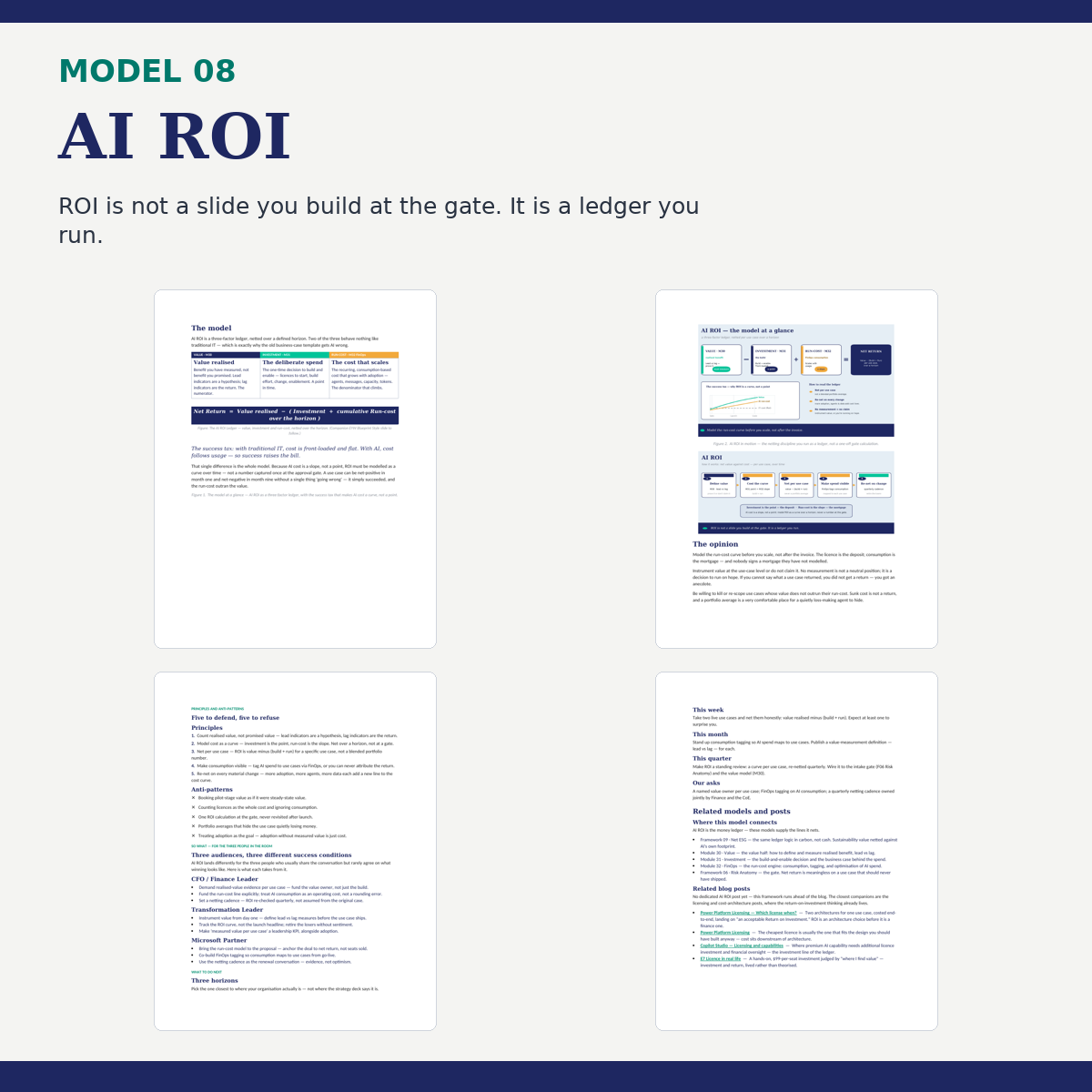
The model treats return as a three-part ledger: value realised, investment and run-cost. The value has to be measured, not promised. The investment is the build-and-enable decision. The run-cost is the recurring consumption that grows with adoption.
The important move is to net the ledger per use case over time. Portfolio averages are too comfortable a hiding place for use cases whose run-cost has started to outrun their value.
This is why AI ROI belongs in the operating cadence, not only in the approval pack. You do not calculate it once and hope it remains true. You re-net it whenever adoption, agents, data, model choice or consumption changes.
The central idea is simple: ROI is not a slide you build at the gate. It is a ledger you run.