
Model 13 · Test before you Trust
AI does not fail like traditional software.
A conventional system can pass a deterministic test and behave the same way tomorrow. An AI system can be accurate on average and still be confidently wrong on the case that matters. It can drift as the world changes, hallucinate under pressure, or be manipulated by inputs its builders never expected.
That makes “we will monitor it” an insufficient answer.
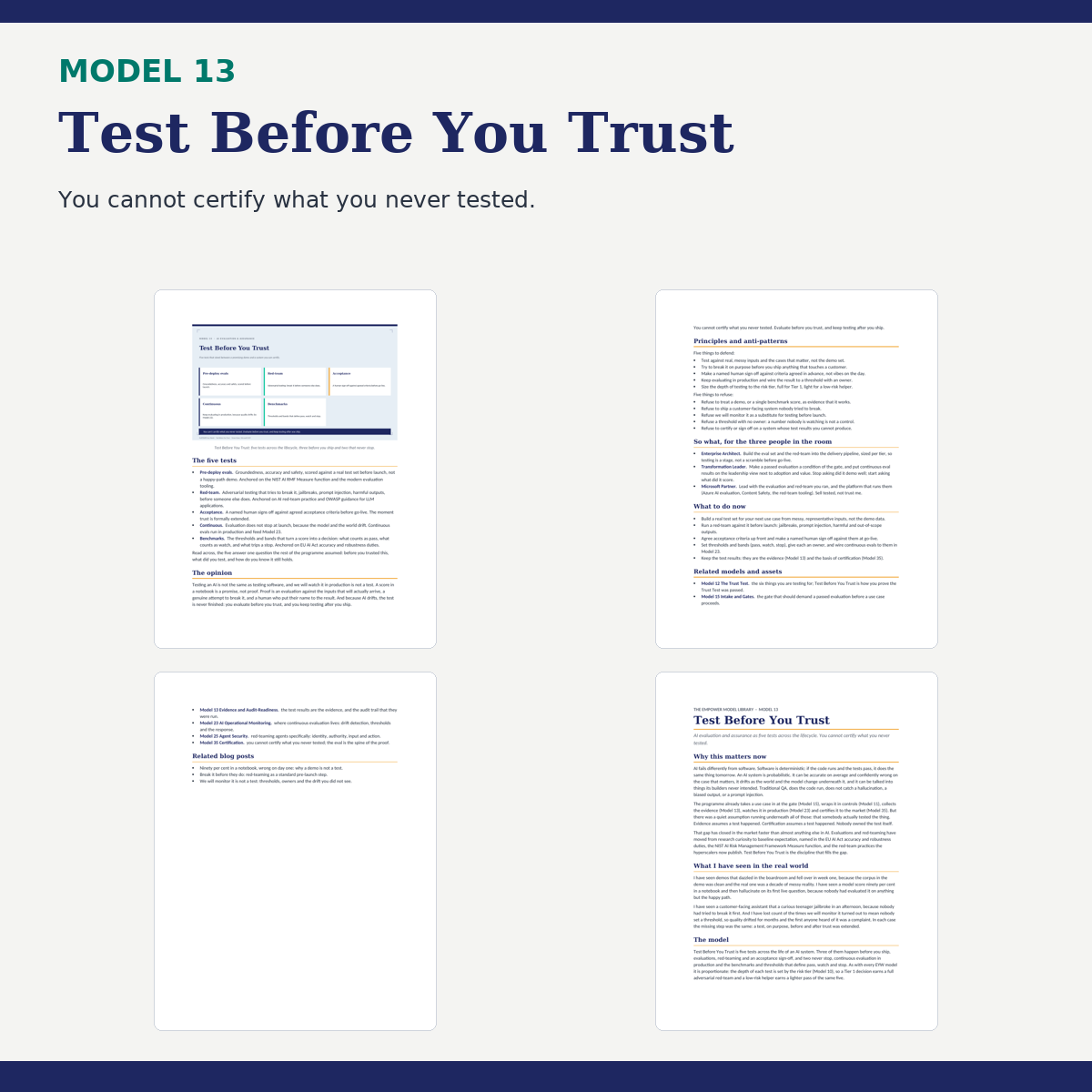
Test Before You Trust defines five tests across the AI lifecycle. Three happen before shipment: pre-deploy evaluations, red-teaming and acceptance sign-off. Two never stop: continuous evaluation and benchmarks that define pass, watch and stop thresholds.
The model fills a gap that other governance processes often assume away. Evidence assumes a test happened. Certification assumes a test happened. Monitoring assumes someone knows what good looks like. But if no one built the test set, tried to break the system, agreed the thresholds and named the owner, trust has been extended on hope.
The depth of testing is proportionate to the risk tier. A high-risk or customer-facing AI system deserves deeper evaluation and adversarial testing than a low-risk internal helper, but both need the same basic discipline.
The central idea is simple: you cannot certify what you never tested. Evaluate before you trust, and keep testing after you ship.