
Building a Digital Transformation Factory
Global Healthcare Enterprise · Technology Strategy · Governance · Architecture · Solution Development · 3-Year Transformation Programme · Completed
CONTEXT
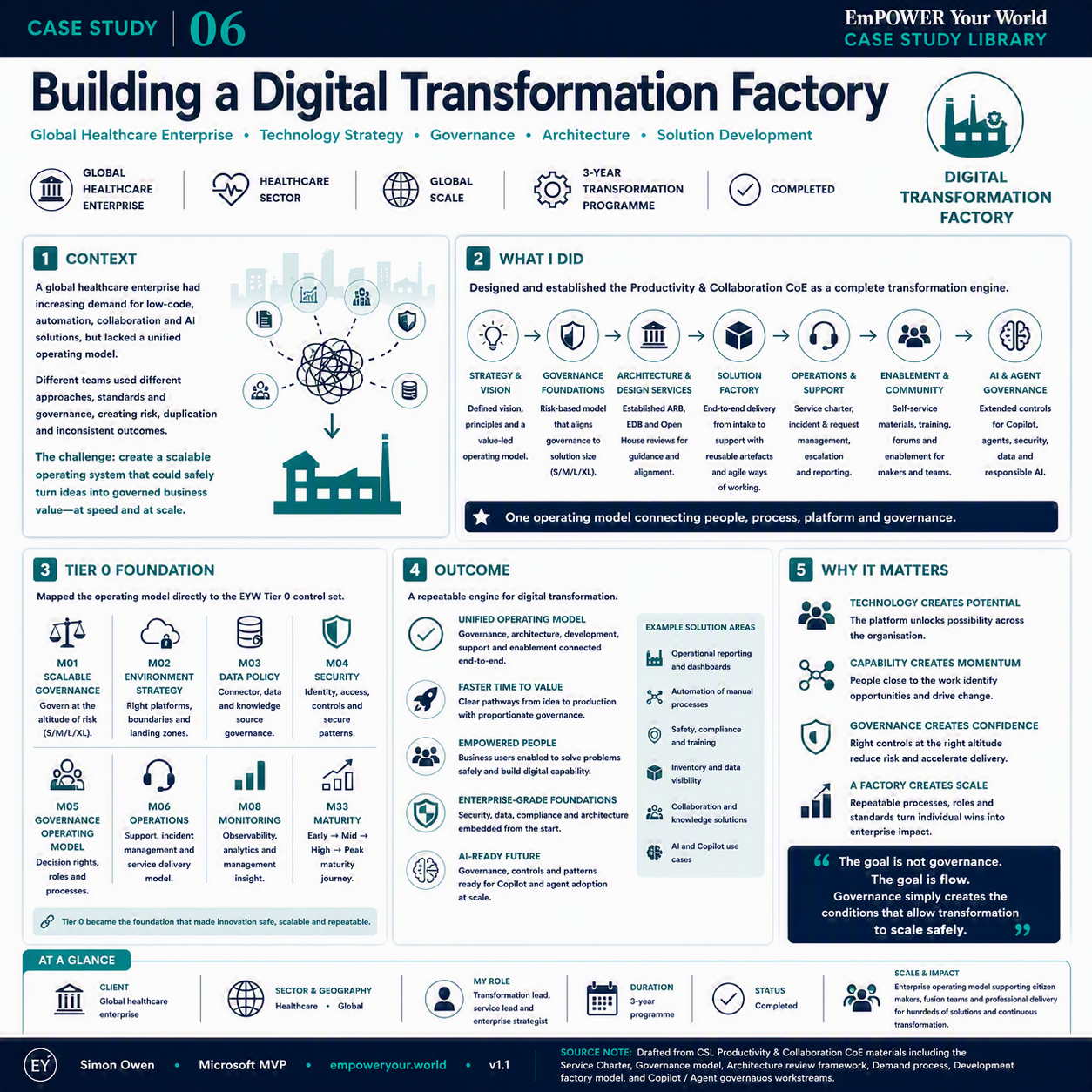
A global healthcare enterprise had significant ambition around digital transformation, automation, low-code development, collaboration technologies and emerging AI capabilities, but lacked a single operating model for turning ideas into governed, supported business value.
Demand was coming from different directions: citizen makers, business-led productivity opportunities, larger enterprise solutions, professional development needs, collaboration-service demand, and emerging Copilot / agent use cases. Without a consistent model, the organisation risked creating fragmented governance, uneven standards, unclear ownership and solutions that were difficult to support or scale.
The challenge was not simply to create a governance document. The challenge was to establish a transformation factory: an operating system that could assess demand, size risk, route work, apply proportionate controls, provide architecture services, build solutions, support makers, sustain live products and advise leaders on strategic direction.
This is the part of the EYW Tier 0 story that turns the modules from teaching assets into a lived operating model: the controls were not abstract. They became service scope, governance gates, review boards, development pathways, support processes, community enablement and AI readiness.
WHAT I DID
· Led the team responsible for designing and establishing the Productivity & Collaboration Centre of Excellence as a governed service, not just a collection of platform capabilities.
· Created the strategic vision for a service that could empower people, build solutions and provide value-based support while balancing innovation with security, architecture, privacy, compliance and operational sustainability.
· Established scalable governance foundations using a risk- and complexity-based model. Instead of treating every idea the same, the model differentiated between small personal-productivity solutions, medium team-productivity solutions, larger business-important solutions and extra-large business-critical or regulated solutions.
· Connected governance to business language. The model assessed solution size through factors such as data sensitivity, business criticality, regulatory impact, user population, process complexity, developer capability, support model, documentation needs, testing expectations and development standards.
· Mapped the service directly to the EYW Tier 0 control set: M01 Scalable Governance for risk sizing, M02 Environment Strategy for platform boundaries, M03 Data Policy for connector and data decisions, M04 Security for access and control design, M05 Governance Operating Model for decision rights, M06 Operations for support and service run, and M08 Monitoring for reporting, observability and management insight.
· Built architecture and design services around formal review points, including architecture review, experience design review, open-house style challenge sessions, business approvals, change governance and demand qualification.
· Designed a solution development factory that moved demand through assessment, qualification, design, development, testing, deployment and support, using repeatable artefacts and gates rather than ad hoc delivery.
· Created the service operating layer: service charter, support model, levels of support, incident and request routing, escalation paths, demand logging, service reporting, cross-charge thinking, customer responsibilities and service-provider responsibilities.
· Established enablement mechanisms for citizen makers and business teams, including self-service materials, a central service hub, a community for peer-to-peer support, training support, collaborative forums and guidance for business-owned solutions.
· Extended the model into AI and agent governance as Copilot and Copilot Studio emerged, defining how agents, M365 Copilot extensibility, Copilot Studio, Power Platform controls, Purview, DLP, authentication, knowledge-source controls, observability and responsible AI considerations should fit into the existing governance spine.
· Provided strategic guidance to leaders on how the service should evolve: from platform governance to solution factory, from solution factory to enablement engine, and from enablement engine to AI-ready transformation capability.
OUTCOME
The work established a coherent operating model for digital transformation: governance, architecture, demand management, solution development, support, community enablement and strategic advisory were brought together as an integrated service.
The organisation had a clearer route from idea to production. Business demand could be assessed, sized, triaged and routed to the right path: self-owned maker solution, supported citizen development, fusion delivery, professional development or more formal governed delivery for higher-risk work.
The model created practical governance foundations rather than theoretical control lists. It defined what needed to happen at each stage of the lifecycle: idea assessment, business case, architecture design, experience design, regulatory assessment where relevant, development, testing, release, support, monitoring and benefits review.
The service model supported both people value and solution value. It enabled colleagues to develop their own capability and solve smaller problems safely, while also giving the organisation a route to build larger, higher-impact and more critical solutions through a more formal development factory.
The same operating spine became extendable to Copilot and agents. Low-code, automation, collaboration tools, M365 extensibility and AI-enabled solutions could be discussed within one governance language rather than as disconnected technology categories.
The outcome was not just a CoE. It was the foundation of a digital transformation factory: a way of repeatedly converting opportunities into governed, supported, value-creating solutions.
TIER 0 CONNECTION
· M01 Scalable Governance — the case study demonstrates the core EYW idea that governance should operate at the altitude of risk, not at the altitude of technology. The T-shirt size model became the common language for deciding how much control a solution needed.
· M02 Environment Strategy — the factory needed platform boundaries, environment decisions and routes for different kinds of solutions, from low-risk maker work to more controlled enterprise delivery.
· M03 Data Policy — connector, data, knowledge-source and DLP decisions became part of the operating model, especially as Copilot Studio and agent capabilities entered scope.
· M04 Security — access, authentication, least privilege, security groups, tenant controls, environment controls and secure agent patterns became part of the design and governance conversation.
· M05 Governance Operating Model — the CoE, sponsors, steering committee, architecture review, experience design, business approval and governance boards turned decision-making into an operating system.
· M06 Operations — the service charter, support levels, escalation model, incident management, service reporting and transition-to-support processes made the factory sustainable after go-live.
· M08 Monitoring — service reporting, management reviews, platform observability, Centre of Excellence Toolkit thinking, Purview and analytics created the feedback loop needed to manage the estate after delivery.
· M33 Maturity — the three-year journey can be read as a movement from early/ad hoc patterns toward a more defined and capable model, where standards, roles, governance and operating practices become repeatable.
WHY IT MATTERS
Most organisations try to scale transformation by adding more technology. That only increases the number of ways to create inconsistency unless the operating model evolves with it.
The real work is building the factory: the governance, architecture, service, support, enablement and delivery machinery that lets ideas move safely from possibility to production.
Governance is often treated as the brake. In this case it became the road system: the lanes, signs, junctions and rules that allow more traffic to move safely.
The goal is not governance. The goal is flow. Governance creates the conditions that allow transformation to scale safely.
AT A GLANCE
Client: Global healthcare enterprise
Sector & geography: Healthcare · Global
My role: Team lead, transformation lead, service architect and strategic advisor
Duration: 3-year project
Focus: Governance foundations, solution factory, architecture services, strategic guidance
Primary EYW connection: Tier 0 foundation modules: scalable governance, environment, data, security, governance operating model, operations and monitoring
Delivery model: Product-led, agile, demand-driven service and solution development factory
CORE INSIGHT
Digital transformation is not a project and it is not a platform rollout. It is the creation of a repeatable system that helps people identify opportunities, prioritise value, build solutions, govern risk, operate services and continuously improve the way work gets done.
Build the factory. The transformation follows.